Showing posts with label Michael Seleman. Show all posts

Thursday, March 12, 2015

Day 112 - Unlimited - Michael Seleman - BHS Senior

This post first appeared on the BHS Collab's Blog
The essay below was the winner of the 2015 Final Thoughts writing competition.
Unlimited
by Michael Seleman
I’ve always been the son, the student, and the brother. Three primary and definitive roles, accompanied by many more, have determined my being through a long list of social guidelines and expectations. All that I was, I was relative to others, i.e. parents, siblings, other students. Report cards, academic awards, and extracurricular achievements gave me the validation needed to fuel my complacency. The person I was beyond these primary roles, mattered not, because this was all I needed to be, or so I was told, and “success” always seemed so readily accessible.
That is, until I dared to commit likely the most drastic act of teenage rebellion humanly possibly; I grew out my hair.
For most of my life I’ve been neatly groomed, per my parents’ request. Never was I permitted to set foot out of the house without my hair, a lofty centimeter in length, combed “presentably.” And for a while, I was perfectly content with this; I’m sure I looked quite spiffy with my conservative haircut, one that proved immutable even in the face of the most powerful gusts of wind Mother Nature might throw my way.
But suddenly, and rather inexplicably, I felt restricted, contained within the metric boundary of my hair. I wasn’t one to express myself through a risqué hairdo, but it irked me that I had never satisfied my curiosity to experiment. Cutting my hair seemed to be inhibiting something more than just hair growth.
Months passed, and having now refused three appointments at Ray’s Barber Shop, my hair had grown to an unprecedented length. Though they dared not force my hand, my parents and friends alike were adamant that a haircut was long overdue. Yet every time I stole a glance at my bedroom mirror, I was surprisingly pleased. The miniature Afro (Egyptian genes at work) was here to stay.
But why bother maintaining something so trivial? Admittedly, it wasn’t the hair that captivated me as I looked briefly into the mirror. It was the man, barely recognizable, that stared back at me. His physical appearance hadn’t notably changed (a haircut, or lack thereof, only goes so far). But for once, he didn’t seem the poster-boy student, son, or brother that he had previously been. For once, he seemed something more, an entity in himself, something dynamic and thus undefined. And he stood with a self-assurance uncharacteristic of the young man who had previously fulfilled these roles. The significance of so trivial a change in my appearance was by no means correlated to its scale.
In growing out my hair, I had exercised my autonomy ever so slightly, thereby altering my self-perception in a manner that I wouldn’t understand immediately. I had seen previously through eyes not my own, through those of my community, my parents, etc. But now, I looked with my own eyes as an individual in the truest sense of the word, one that need not be classified as one thing or another to find purpose. I was, rather, I am my own.
I no longer define myself as solely the son, the student, the brother. Who I am, who every human being is, is more than a list of positions, relations, and achievements. Accordingly, the individual, dynamic in nature, has the capacity to distinguish himself, and often strives to do so through the pursuit of a passion, ironically with its own roles or titles. It is when the individual allows these roles to define his essence that they become limiting factors of his identity, rather than those which empower him to thrive in the relationships and opportunities allowed him daily. I want to study biochemistry, maybe even pursue a career in medicine, but I don’t want my concentration or any title that I may achieve to limit my perception of myself. I am unlimited, and that affords with it a passion that no titular pursuit can ever bring.

Friday, March 6, 2015

Day 108 - We're Not Monkeying Around - BHS Help Desk Students Develop App

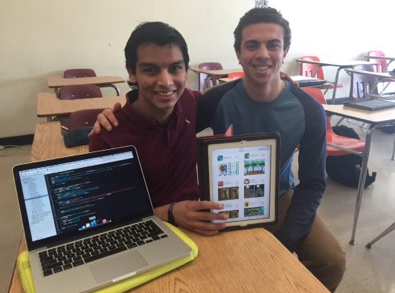
I’m SUPER excited and proud to share that Manas Purohit and Michael Seleman, both seniors and first year members of the BHS Help Desk, have successfully developed an iOS application that is available for download for the iPad and iPhone. Banana Boom puts “your reflexes to the test” while users “tap to dodge explosive bananas as Super Sam (your heroic monkey) maneuvers down some series slopes. Collect coins to rack up points, but only if you’re up to the task; some coins can be tricky to grab!” The app requires iOS 8.1 or later and is optimized for iPhone 5, iPhone 6, and iPhone 6 Plus.
Screen Shot 2015-03-03 at 1.27.45 PM
BHS Help Desk Genius Bar Staff Members Manas & Michael - Developers of Banana Boom!
20% Time Project Part 1:  
The development of this application is part 1 of Manas's Individual Learning Endeavor, or his 20% time, genius hour passion project. The ultimate goal for his ILE is to develop a Help Desk mobile application, with an anticipated launch date of April Fool’s Day (no joke!)  Michael is no longer enrolled in Help Desk for the second semester, however he will continue to collaborate with Manas on the Help Desk app as an equal partner. Below are the details of how Manas and Michael went about programming their first iOS app and what their plans are for part 2 of their ILE; a BHS Help Desk mobile app.
Where did the idea for Banana Boom come from?
“It came from the old Mario game where Donkey Kong is throwing barrels against Mario. We thought, ‘what if we put Donkey Kong on a sled and made him dodge bananas?’ Then we added the coins as a scoring mechanism.”
What were the steps involved in the development of the app?
“First, we had to learn the programming language Objective C. After doing some online research, I decided to use the bookBig Nerd Ranch Objective C Guide because it was recommended by professional programmers. I used that book as my major resource. I prefer to use books over videos because you actually see the code written out and refer to it as you type along. I also had to learn how to use the software GIMP, which is similar to Photoshop. This is what we used to make the images in the game. We drew all the images pixel by pixel, which gave us superior precision over the exact view of the images.”
What was the hardest part of creating the app?
“I’d say the scene where the monkey is actually dodging the bananas. We had to make it difficult enough so the user wasn’t bored by the game, but at the same time, not so difficult that the user gave up on it. We had to spend hours adjusting the speed at which the bananas came down in order to get the perfect velocity. It took two and a half weeks start to finish to build the app. Then it took a week for Apple review the app and actually put it in the app store.”
How did  you go about submitting the app into the App store?
“First we had to get a developers license. We went to the Apple Developers website and we had to sign up for the developers programs. That cost $99 but that was well worth it because that’s the only way you can get an application on a device versus a simulator. It only took a day for the processing to go through. Once we had the license, we connected it to Xcode. Then we had to complete an application through iTunes Connect. We had to fill out the description of the app, general information, the copyright, the license agreement, what other capabilities our app had (Game Center for example) and finally we uploaded our code and all our images to iTunes Connect. We also had to put in screenshots for app previews. Then we submitted it for review. It took approximately one week from the time we submitted the application to when it actually became available in the App Store. I received an email from Apple last night that said, ‘the following app has been approved and is ready for sale.’
Why did you decide to make the app free? 
“We as students would most likely not pay for a game, so we thought that most of our users would go through the same thought process, so making the game free would result in the most downloads, which was our goal. If you can get a lot of downloads, you can have ads on your application which could allow us to eventually make profit.”
How will the creation of this app help you develop the BHS Help Desk app?
We are now more experienced as far as user interaction goes on iOS devices. So, using this knowledge we can create a better user experience for the users of the Help Desk application. Additionally, we know how the app review process works with Apple and we can configure the app so that it is reviewed and available as soon as possible.
Screen Shot 2015-03-03 at 8.49.48 AM