Showing posts with label Keys to Literacy. Show all posts

Wednesday, June 20, 2018

Day 176 - Top Down Webs - Mrs. Janis - Francis Wyman Grade 4

This post first appeared on the Keys in Burlington Blog


Students read the core book “The One and Only Ivan.”  Students shared character traits of each main character in the story and evidence to support the trait.  Students shared their traits and evidence and posted it under the correct character throughout the novel.  At the end of the novel, students selected 1 character and wrote about the character’s trait using the evidence in their writing.

Main Idea Activity

Students were given a photocopied National Geographic article about pollinators.  The headings of each section were cut off and the article was cut up too; even the pictures.  The students worked in small groups reading each section, They had to decide which of the cut up headings matched each section.  Once they did that, students had to recreate the article from beginning, middle and end and glue them on construction paper with the pictures that matched each section.

After the “Pollinator Parade,”  Students sorted notecards to create the Top Down Topic Web.  This can be used as an assessment. Facts about pollinators were written on notecards,  Students worked in groups to create the TDTW.


Students used an ice cream parlor menu to create Bloom’s Taxonomy questions about the menu.  They used a “Cheat sheet” to help familiarize them with the correct vocabulary for each question.  Once each group wrote a question for each level, they were dispersed among the groups so each group had 6 new questions.  Once everyone is done, the group would read aloud their question and share what level the question is and the vocabulary they used to make them decide what level Blooms the question is.  I shared the Bloom’s questions with another teacher to introduce Bloom’s to her class.


Students read an article in National Geographic about different kinds of giraffes.  We did this activity as a whole group. We discussed how we could organize the information and facts we read in a TDTW.  The class decided the heading is giraffes because that’s what the article is about. Then they discussed what the next level should be and they decided the types of giraffes.  Then students worked in small groups to find details about each type of giraffe and they shared the details on the rug and I wrote the details down. We also discussed the different shapes and colors to use in the TDTW.


Sentence Sort

Each student wrote 4 sentences (one of each kind of sentences) without an end mark.  The sentences were then put into a pile. Each student got 4 new sentences. They had to read each of their sentences aloud and then they had to add the correct punctuation and place it under the correct heading, either exclamatory, declarative, interrogative or imperative.

Friday, June 15, 2018

Day 173 - Categorizing in Grade 2 - Mrs. Mondello - Memorial School Reading Specialist

This post first appeared on the Burlington Keys to Literacy Blog

Students sort and categorize pictures words and objects across the curriculum and from the very start of Kindergarten. This year’s KTL training gave me a deeper understanding of how learning to organizing words and discussing the connections between and among a group of words is the beginning of implied main idea. When a child can articulate the connection within a group of details they begin the process of finding the main idea. 

In this activity, we asked a second-grade group of students with experience in categorizing words into previously labeled buckets, (labels) to sort then identify the labels for the buckets. The discussion groups got right to work sorting and determining how to organize the words. At first glance kids impulsively sorted into two clear categories, winter and summer then hit a roadblock with nouns that were places, like TD Garden and Fenway Park. 

Eventually, paired groups brought their category labels to the rug where our larger debate happened. The final two labels given were Bruins hockey essentials and Red Sox Baseball essentials. This was engaging and only took about 15 minutes. 


Monday, June 11, 2018

Day 165 - Categorizing in Grade 3 - Mrs. Johnson - Memorial School

This post first appeared on the Burlington Keys to Literacy Blog

I have been working with third-grade students on KTL strategies for a few months now. They have had numerous opportunities to categorize, starting with everyday, familiar vocabulary such as sorting appropriate vs. inappropriate behaviors in reading class which we used as a review of the class behaviors they had generated, as well as types of food, basic vocabulary to review nouns, verbs and adjectives, and so on.

Students have also had experience using top-down webs to organize their ideas for writing a paragraph, and have also been guided through generating details for scaffolded 2-column notes on short stories and Newsela articles.

One of the core books for third graders is Helen Keller. This book is a challenge for this group of students, so using KTL strategies was certainly helpful. First, we did an adjectives word sort to describe Annie Sullivan and Helen Keller. We read the words to them and discussed their meaning. Then, students worked with a partner to sort the words. The discussions that evolved around this word sort led to a much deeper understanding of the characters particularly since several words could have applied to each of the characters for different reasons. Students were able to support their reasons with examples from the test. 


After reading a chapter, students worked with a partner to sort sentences from two paragraphs which told about two different events in the text then wrote the main idea of each paragraph.


Most students were able to write what the paragraphs were about but some needed more discussion...a work in progress.

Monday, May 14, 2018

Day 148 - Two-Column Notes in Grade 4 at Memorial - Mrs. Harlow

This post first appeared on the Keys in Burlington Blog

Students in fourth grade learn about the five geographical regions of the United States. They are expected to know states, capitals, geography, and how the regions differ from one another. We use the online program called Teach TCI so students can access this information on their iPads. I decided the best way for my students to understand each region is to read/listen to each section and use 2-column notes to write the most important facts. Students that struggle with what to write can use the “main idea” tool which highlights the most important facts. Each student writes the facts in their own words using abbreviations, as needed. I also allow for students to draw pictures of these facts, if necessary. 

To set up their 2-column note, I have students fold their papers or create the lines based on the ⅓:⅔ ratio. Then they label the topic of their section. In this case, students labeled their notes as “The Southeast Region”. The ⅓ section, or main idea, is usually labeled based on what city or town they are researching and why. For example, the first section of the southwest region is called Monument Valley - Home of the Navajo, therefore students will write Monument Valley, Utah - Navajo Indian Reservation. On the ⅔ side, students will write anywhere between 3-4 facts about Monument Valley.

Once students finish all of the sections for the Southwest, they will use their 2-column notes to write a summary. I have taught the regions for a few years now and found that using 2-column notes and turning them into a summary is the best strategy to make the information stick. Students are also learning a skill that will carry over when completing research projects that will require them to only include necessary information. I have used this strategy since the beginning of the year and can now say that most of my students are at an independent level. 

Tuesday, April 24, 2018

Day 134 - Two Column Notes and BrainPop - Mrs. Casey - Francis Wyman Grade 5


While watching a BrainPop video about poetry, grade 5 students took two-column notes to gain information.  They were allowed to use their notes while completing a multiple-choice quiz about the video. They were able to find important details that went with each section about the video including prose, poetry, meter and rhyme. This is an important skill to learn as many people now get their information from online videos, YouTube, etc.


Thursday, April 12, 2018

Day 131 - Keys to Literacy in Action in the Art Classroom - Ms. Chang - BHS Art

This year we had wonderful training on Keys to Literacy. I learned helpful techniques to better engage students in reading and writing in my classroom.

Here is a link to the school system's blog with loads of resources and samples:
http://keysinburlington.blogspot.com/
I was a test pilot for the Scholastic Art Magazine this year and worked to incorporate readings and discussions from these magazines. The students found the articles interesting and engaging. I would highly recommend the magazine as it offered insight into contemporary and historic artists and gave the students relevant articles and high-quality images of a wide variety of works of art.

Below is the template that I used for two column notes and a student sample based on an article about the sculpture " Fearless Girl".

Picture
Picture

Tuesday, April 10, 2018

Day 129 - Using Two-Column Notes for Researching & Writing from Sources - Mrs. Graham - BHS Teacher Librarian

This post first appeared on the Burlington Keys to Literacy Blog


When it comes to analytical research papers, students often struggle with dissecting complex secondary sources. Solid research-based writing, though, necessitates not only that students comprehend critical articles, but also that they can synthesize the ideas from them with their own analysis of the primary source. Two-column notes provide students with an entry point into secondary texts by focusing their reading. Such notes are also a quick and effective way to evaluate students’ comprehension and to identify students’ misconceptions.

Mrs. Shalkoski’s junior English class, for instance, used secondary source information to enhance their examination of “John Proctor as the Tragic Hero in The Crucible.” In their two-column notes, they recorded key tragic hero traits, which could later be turned into topic sentences, on the left. We then modeled a think aloud for the first two paragraphs of a critical article, having students identify text-features and select quotes that could fit the right-hand-side of the chart. Students then collaborated in groups, annotating their texts, discussing “big ideas” and key points, and recording salient details. Doing so allowed them to draw connections, synthesize ideas, and substantiate their arguments. Ultimately, they used their two-column notes as a starting point for their analytical essays.


Recording research in two-column notes also helps students to clearly organize their points to develop summary writing. In Ms. Duhamel’s Spanish I class, students used two-column notes to research and record the characteristic of animals, which they then turned into cohesive summaries written in Spanish. Similarly, her class relied on two-column notes in investigating a famous Spanish speaking individual of their choice. They then presented a biography of their individual to their class in Spanish using Google slide presentations. Selected individuals included Paco de Lucia, Julia de Burgos, Octavio Paz, Pablo Picasso, and Roberto Clemente, among others. Duhamel noted how these projects pushed students to learn and utilize vocabulary and grammar structures in their writing and speaking that they typically might not encounter until Spanish II or III.

Thursday, March 29, 2018

Day 122 - Getting Creative with Question Generation - Mrs. Del Llano - BHS Special Ed. Staff

This post first appeared on the BPS Keys to Literacy Blog


Without a doubt, question generation is my favorite Keys to Literacy Comprehension Strategy. While this can partially be attributed to my natural inclination to ask too many unanswerable questions, the deeper reason I enjoy question generation is the enthusiasm it elicits from students. 

Recently my English co-teacher and fellow KTL coach, Emily, and I decided to reintroduce the question generation technique to our 9th grade College Prep classes. After spending a generous amount of time during quarters one and two implementing main idea and summary writing as a means of assessing reading comprehension, we decided it was time to mix things up for To Kill A Mockingbird. We began by reviewing each level of Bloom’s Taxonomy as a large group discussion and asked students to generate questions for each level using the object of a smartphone. Students were then encouraged to share their questions. This process was a very beneficial one, as it preempted students to examine how and why questions fit a particular level. Once we felt students had a decent grasp on the different levels, we assigned students in groups of 3-4 and had them generate 2 questions per level about a character from the novel. Questions were focused on whether or not this character is a good person. For the first part of this exercise, we asked students to only generate questions, not answer them. During this activity, students were engaged and lively. I have found this to be the case when the pressure of needing to find a “correct” answer is removed. Students seem to feel freer to ask questions and discuss them when they know they are not being formally assessed. 

Since this lesson, we have used question generation as a method of assessing students’ reading comprehension after each chapter. In response to the quality of their questions, we have chosen for some chapters to require only Analyzing and Evaluating question generation. With others we, (as the teachers) have asked students to answer pre-generated Remembering and Understanding questions, then in groups asked them to generate questions for Applying and Creating and swap with other groups to answer the questions. There is a lot of freedom and flexibility with question generation. Incorporating this strategy into our instruction in this capacity has been a fun, energizing way to assess our students’ reading comprehension and critical thinking skills.

Tuesday, February 27, 2018

Day 105 - Scaffolding Summary Writing - Ms. Bilotta - BHS Math Dept.


When Keys to Literacy was first introduced, I had the most difficulty with assigning students summary writing. As a math teacher, my original opinion was that summary writing took too much time to do and that the class would fall behind on the curriculum if I regularly incorporated summary writing in my classroom. What I failed to recognize is that the value of student comprehension outweighs the extra time spent. If students truly comprehend the material initially, there is less time needed in the long run for review. Summary writing is also a great study tool before tests, as it allows students to focus on the main ideas and recognize what is most important while studying.

Easier said than done, right? At first, probably. Remind yourself that it is absolutely okay to dip your toes into the water before plunging in head first. I used to shy away from summary writing because I thought I needed to jump from 0% to 100% overnight; that is not the case. One of the ways I first dipped my toes in was by making my own summary, and then scaffolding it for the students. To put it simply, I came up with a summary and removed pieces of it for the students to fill in. The example below is a scaffolded summary for percentile rank that I gave my probability & statistics students this week as a tool to help them review for their upcoming test. It is a new course this semester (about three weeks in) so many of them do not have experience yet with summary writing. I decided it was best to ease them in with a scaffolded summary on percentile rank. The students cut out the pieces of the table on the bottom and pasted them into the appropriate blank spaces.


See completed summary below:

The students had to understand the overall big picture in order to complete this task. They showed comprehension of the topic by correctly putting the pieces together, and now they have a summary to hold on to that they can study from. Students also reread the summary repeatedly which helped to retain the important information. This summary was particularly important for this unit because there are so many elements to finding percentile rank that many times the steps required are broken up. For example, maybe I only have students calculate the standard deviation, or maybe I skip a few steps and give them the z-score to have them go from there. It is important that the students recognize how all of the pieces come together and understand how the whole process works. Eventually, the goal is to have students complete summary writing all on their own, but it is absolutely beneficial to guide them along the path to summary writing as well. Now go dip your toes in!

Wednesday, February 7, 2018

Day 97 - Writing Effective Arguments - Mrs. McCarthy - BHS Special Ed. Staff

This post first appeared on the Burlington Keys to Literacy Blog

Keys to Literacy offers a great workshop on writing effective arguments, and breaks down the process into manageable chunks to guide students and teachers through the process. After attending the workshop, my co-teacher Rebecca Bernard and I created a writing assignment for our Sophomore English students to argue for or against the United States Travel Ban. First, we had students read an article outlining both perspectives. We had them highlight in different colors, arguments for and those against. Students transferred these ideas onto a planning sheet.


After students have formed their opinions and chosen their position, based on what they have read, we introduced them to the structure of the argument essay.


As seen in the photo above, there are three major parts of the essay, just as with analytical writing: Introduction, Body and Conclusion, but instead of the PIE structure, the paragraphs are structured based on reasons and evidence, as well as the opposing point of view, or counter-argument, which is followed by a rebuttal. Students do need encouragement to write their opinion, given we have disallowed it for their analytical writing. 

Below is the link to the assignment and planning sheet:

https://docs.google.com/document/d/1v5n568GWKvAe1X-YbYs2WqWvMpaZ9uXBErPHR9RDhvE/edit


When your students have completed the assignment, the KTL website contains rubrics for argument writing that closely examine the elements needed for an effective essay.

Monday, January 29, 2018

Day 90 - Categorizing for Deeper Understanding - Ms. Merlino - Pine Glen Grade 4


As the year progresses, the students in this ELA class have been working on categorizing skills. The ability to sort objects, vocabulary and book content has helped us learn how to categorize.
We are now starting to work on using these categorizing skills to start finding the main idea in a passage. Below are pictures of students working on categorizing the names of characters from The Orphan of Ellis Island, a fourth grade core book.

They had a great discussion on which characters were really the protagonists and which were antagonists. Where do you put their names? Does one bad act make them a bad person? How do we know if something they did is truly bad? These were all topics of debate in the class, and now we’re writing to argue our points.
As the categorizing skills progress, our understanding of the book and other texts deepens. We are able to grab the deeper meanings of the story, develop and ask a variety of questions (Bloom’s Taxonomy) and hold debates rather than just answering a question.

Tuesday, January 23, 2018

Day 86 - I, We, You- Releasing Responsibility to Students - Mrs. Cheever and Mrs. Graham - BHS Science Dept.


As we reach the halfway point of the school year, it would be a good time to try to release some of the note-taking responsibilities to the students. It’s a perfect time to transition from the “I” to the “we” (or even “you”) version of the notes. Presently, in our science classes, it has primarily been the teacher providing the students with a scaffolded version of notes to follow along with while the information is being presented. Now, we think it’s a great time to make the students utilize this KTL strategy. First, you can continue making scaffolded notes, but start with removing all the left-hand side information; have the students start coming up with ALL of the main ideas. Then, once they get the hang of that, start removing more of the details on the right-hand side as well.

We have found that reading from a text is a simple way to begin this gradual release of responsibility from the teacher, as it can be difficult to give students a mostly blank sheet of paper when you are lecturing (or in science classes when completing a lab). Additionally, it is hard to give up control and allow the students to think for themselves about the main idea or to decide what is important to write down from what you say. A second idea of how to release responsibility would be to show the students a top-down web of what the unit is going to be about and have them create the 2-column note boxes. This is a simple way for them to know some of the basics ahead of time such as how many boxes to include in their notes and what main ideas they should be including.

In conclusion, releasing responsibility will most likely be a slow process as the teacher learns to give up some control, and the students learn how to be more proactive in their classes. In the end, the goal is for students to be able to take notes from anything read, said, or done on their own and not rely on the teacher to spoon-feed them all of the information. As we start the new term, we think it’s a perfect time to relinquish some control in our classrooms and encourage our students to use their critical thinking, application, and analysis skills!

Wednesday, January 17, 2018

Day 82 - Exam Review with Keys to Literacy - Ms. Bularzik - BHS English Dept.

My favorite way to help students study for midyear and final exams is study stations. I set up eight to ten stations around the room, let students choose four to five stations they want to visit and have students switch stations every ten minutes or so. For classes that need more structure, I set up fewer stations and have students rotate through all of them in assigned groups.

Study stations work well because they give students choice and variety. They also require students to decide what they personally need to work on, and students tend to appreciate this independence. My stations are never all KTL (I like including a “locate all your notes” station, for example), but many of them are. Here are a few of my favorites:

Categorizing
Give students a list of some or all of the key terms that will be on the exam. Have students develop categories and sort the terms. Students could also sort terms by how well they know them and then write down the terms they need to study most.


Top-Down Webs
Have students turn a list of key terms and concepts into a top-down web.

Have students use their own notes, handouts, etc. to develop a top-down web for all the material covered throughout the semester.

Rewrite your exam review guide as a partially completed top-down web to help students see the relationships between concepts.


Two-Column Notes
Rewrite your exam review guide as a partially completed two-column notes chart.

Have students condense their notes from the unit into a new set of two-column notes covering the most important ideas.


Summary Writing
Assign different groups of students to summarize different units or key concepts. Share these as a class resource.


Bloom’s Taxonomy
Using all levels of Bloom’s, have students create questions they might expect to see on the exam.

After groups create sets of questions, have them trade their questions with another group and answer them.

Have students create sets of Bloom’s Taxonomy questions and put them in different boxes according to their level. Use these questions for a review game, using different levels of questions for different activities or tasks.

Thursday, January 11, 2018

Day 79 - Francis Wyman 5th Graders Using KTL Strategies - Mrs. Clancy - Reading Specialist


A group of fifth graders at Francis Wyman School are using the Keys to Literacy Comprehension Routine to deepen their understanding of text and non-text. The students are part of an intervention group that is becoming successful in using Top Down Topic Webs and Two Column Notes! This week’s lessons involved reading an article from NEWSELA, taking Two Column Notes, and determining the central idea of the article. Students were then successful paragraph writers! Way to go boys and girls!


During our first meeting, students read the article, Above and Beyond: Teacher’s Letters Make Former Students Feel Special by Sun Herald. The article was found on Newsela, a database of current events stories tailor-made for classroom use. Students worked to complete scaffolded Two Column Notes about the article. Taking Two Column Notes allowed students to record key supporting details. Students gained practice in gathering and organizing information (as well as practicing their reading fluency) as they reread parts of the text multiple times.


At our next meeting time, students revisited the news article and their Two Column Notes. Students were guided to determine the main ideas embedded in their notes. There was a rich discussion of the big ideas. Listening to the students converse, and even debate was exciting. Proud moment! Students added to their Two Column Notes as the conversations took place.


Students used their Two Column Notes to write a short paragraph that explained the central idea of the article. They worked independently to show what they knew. Students used the KTL routine as they increased their comprehension skills. All in all, an exceptional learning experience for our Burlington students! As a Reading Specialist, I am loving what the Keys to Literacy Comprehension Routine are doing for my students. Students are becoming active and strategic readers!

Tuesday, November 7, 2017

Day 45 - Elements of a Fictional Story using Top Down Topic Webs and Two-column Notes in Grade 4 - KTL Blog


Having been recently trained in the Keys to Literacy Comprehension Routine over the past few months, we are slowly “getting our toes wet” with the routines. We are implementing the research-based routines throughout our curriculum, including ELA block with our fourth graders.

We decided to create a Top Down Topic Web (TDTW) as a teaching tool to guide our unit on the elements of fictional stories. We found that the TDTW was beneficial for both the students and teacher. It provided an organized outline of the unit that we were teaching. It also served as an anchor chart that could be referred to as we worked through the unit.

File_000.jpeg


Our next step was to further explore each element of fiction. We used both TDTW and two column notes to do this. We modeled the routine as a whole class and then we incorporated the routine into guided reading groups with differentiated texts. The tasks were scaffolded for each group based on our objectives. For some groups, teacher notes/webs were provided. For others, partially completed notes/webs were provided.

We found that after modeling, it was easier for students to apply the routine to a differentiated book. The shared experience gave the students an example to look back at when they were trying it on their own.
Here are some examples of how we did this:
File_000.jpeg


Scaffolded Plot for Guided Reading

File_001.jpeg

Read Aloud and Model

FullSizeR.jpg   FullSizeR.jpg
Two examples of using Two-Column Notes During Guided Reading

Friday, November 3, 2017

Day 43 - Crazy about Categorizing! - MSMS Foreign Language Teachers


Here in the MSMS Foreign Language Department, we have been using categorizing as a KTL strategy throughout the year. Categorizing requires students to use main idea skills. Students are learning level 1 vocabulary for a foreign language in middle school. It can be beneficial for students to categorize this new vocabulary in a variety of ways to help with memorization and usage.
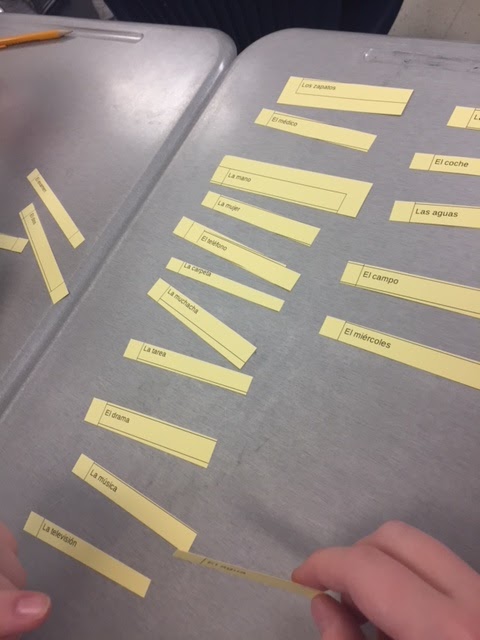
Students enjoy the “labeling the bucket” activity in Ms. Mirabella’s class. Depending on the section of vocabulary, students can categorize their vocabulary into groups, either by topic or parts of speech. 7th grade Spanish students in Ms. Mirabella’s class were introduced to the gender of nouns recently, which operates differently than it does in English. All nouns, living or nonliving, have a gender in Spanish: masculine or feminine. Students were taught how to properly identify the gender of nouns, and even identify exceptions to the rule.
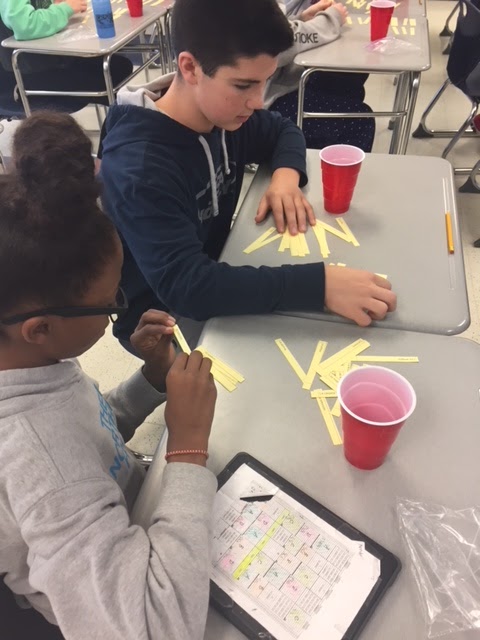
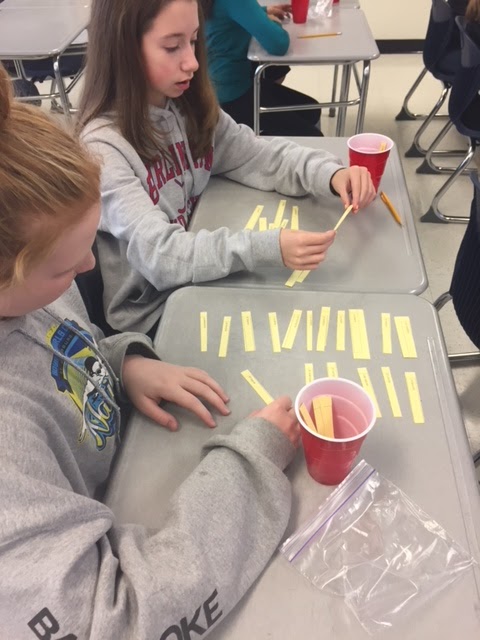
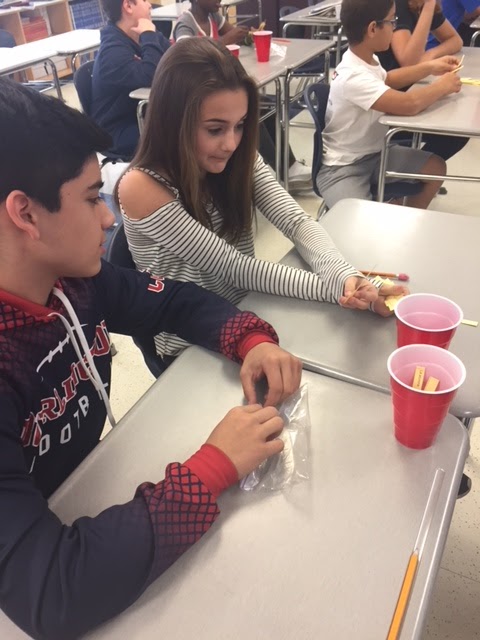
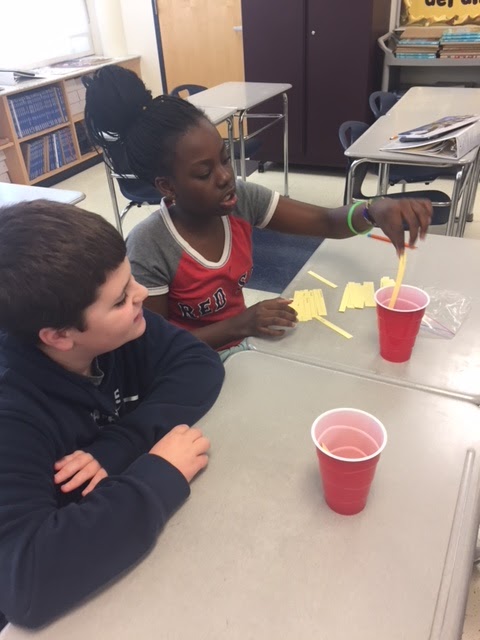
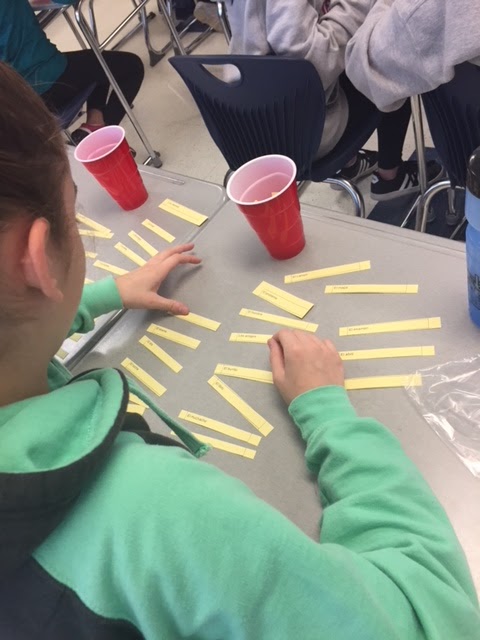
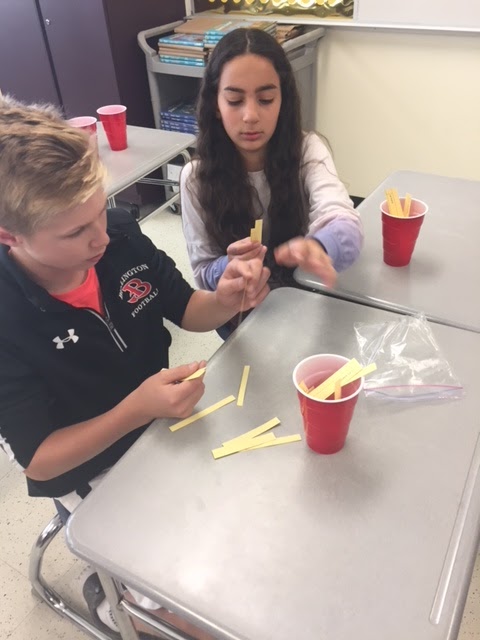
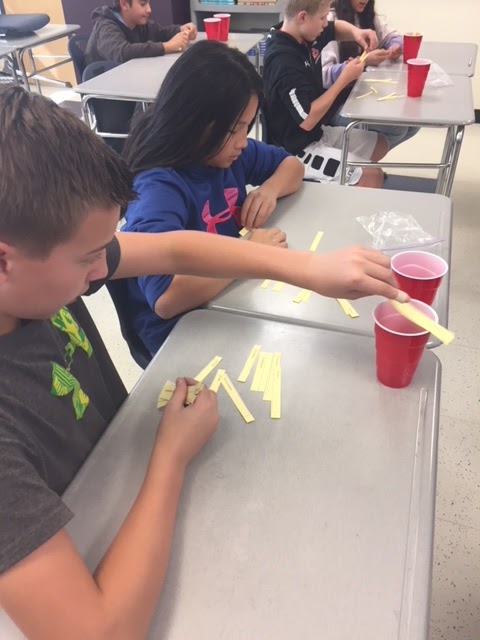
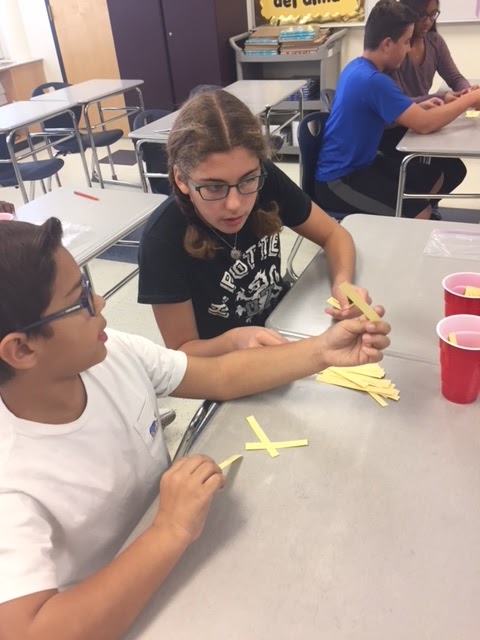
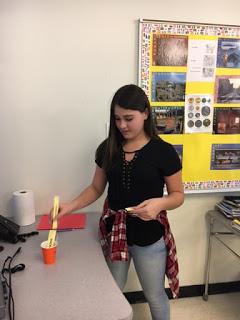
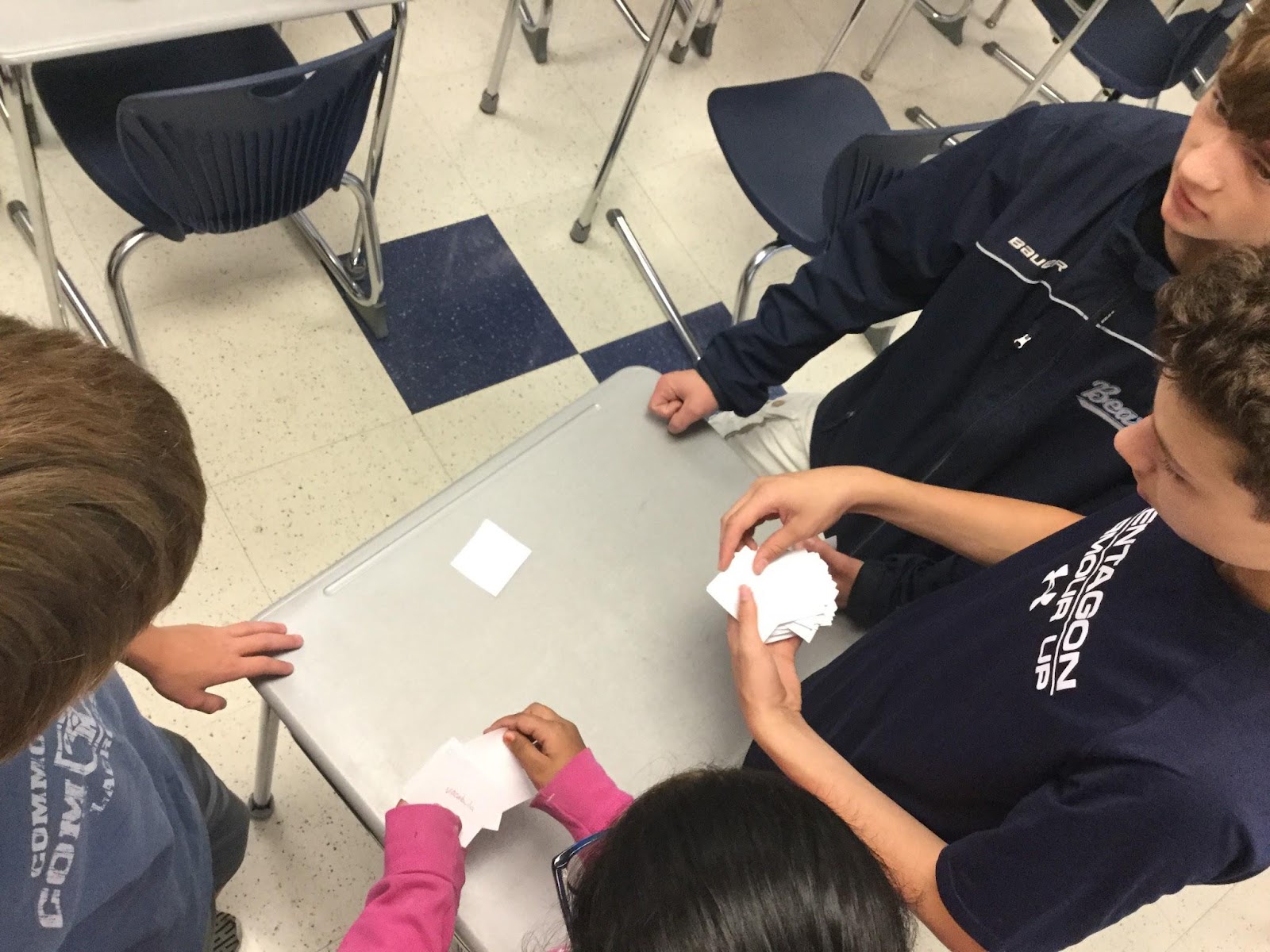
Ms. Mirabella gave each pair of students two cups (in place of buckets) and a ziploc bag filled with nouns on individual cutouts from cardstock. Each pair had to work together to put the feminine nouns into one cup and the masculine nouns into the other cup. When all pairs had completed the activity, students emptied their cups and shared their findings. Students were required to explain why they put a noun into a certain cup using the rules that were previously taught. This activity promotes collaboration and recall, and is a multisensory way to reinforce an important grammar lesson in Spanish. (Pictures below!)

IMG_4771.JPGIMG_4775.JPGIMG_4774.JPG


IMG_4780.JPGIMG_4783.JPGIMG_4776.JPG


IMG_4794.JPGIMG_4792.JPGIMG_4784.JPG
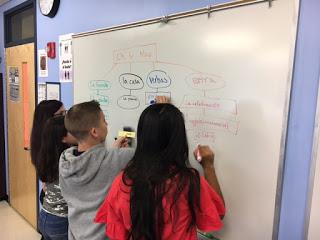
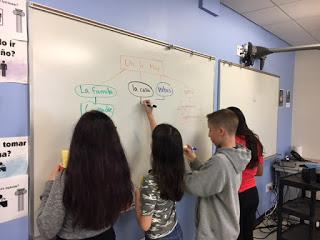
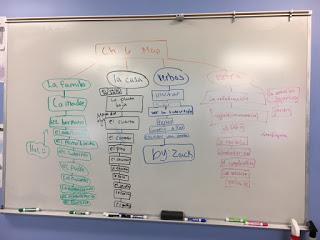
Mrs. Barkley’s Spanish classes are also categorizing. Her 8A and 8B classes did a KTL lesson using bucket sorting and top down webs!


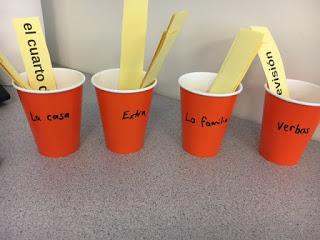
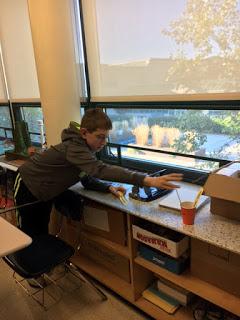
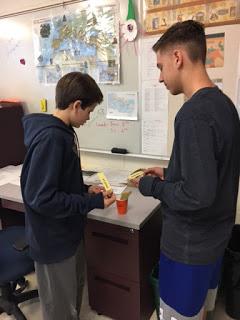
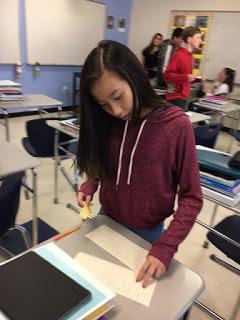
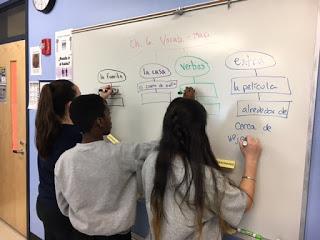
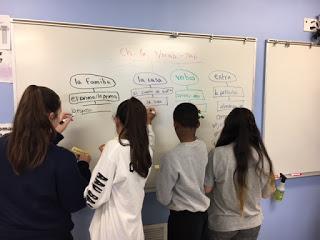
First, each student was given 2-3 Spanish words on a piece of yellow paper. They all got up and were asked to sort their vocabulary words by placing them in the correct buckets (la casa- house vocabulary, la familia- family vocabulary, verbos- verbs from their vocabulary, & extra- words from their vocabulary that didn't fit into the other 3 categories):


Then, volunteers came up to help organize all of the categories onto a Chapter 6 Vocabulary Web:


IMG_0128.JPGIMG_0122.JPG
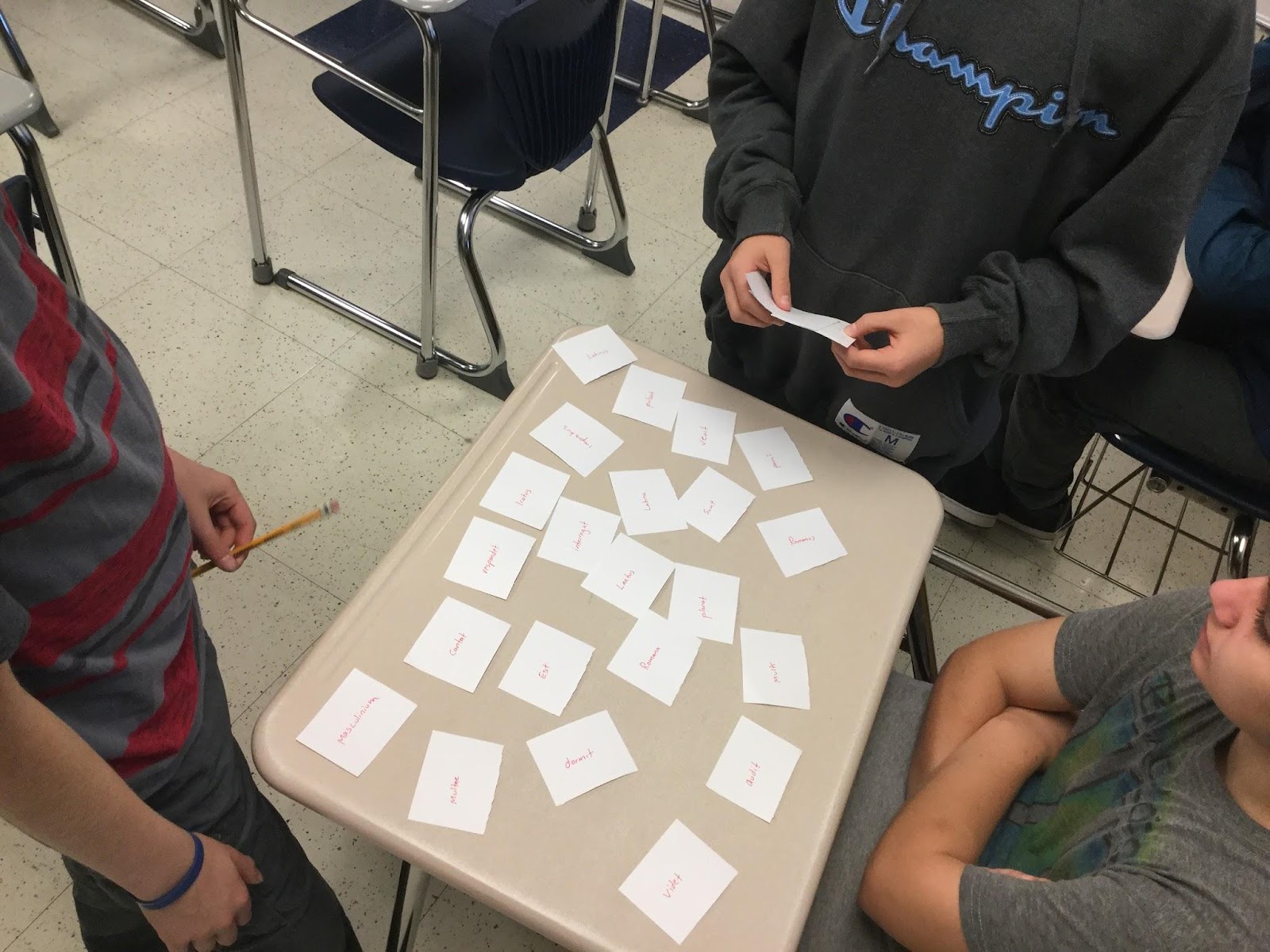
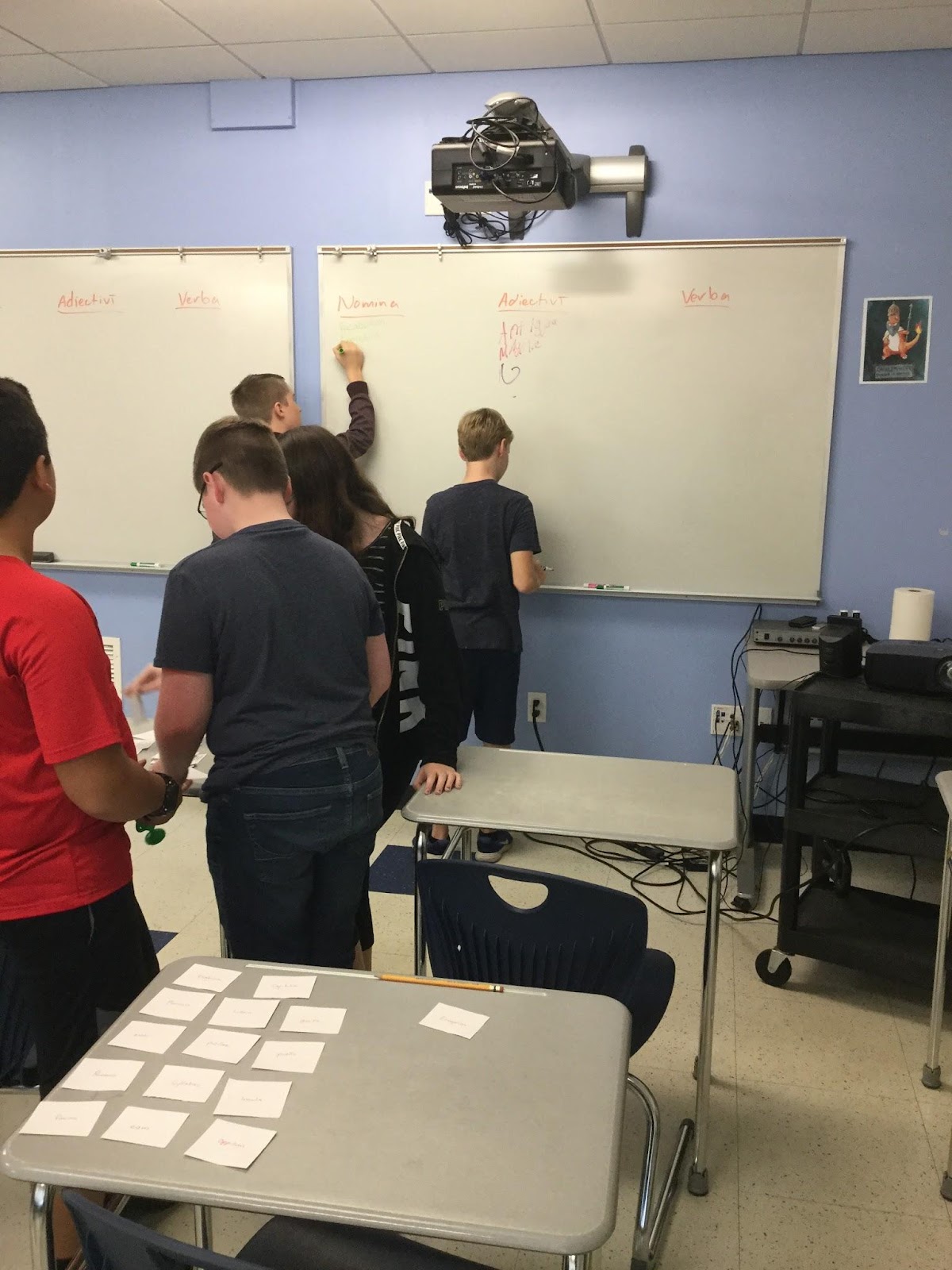
Mr. Walsh uses categorizing in his Latin classes. Both 7th and 8th grade students took part in a group activity to sort new vocabulary words in different ways. First, students were divided into two teams. Each team was given a pile of vocabulary words, which they had to sort into three piles based on parts of speech.

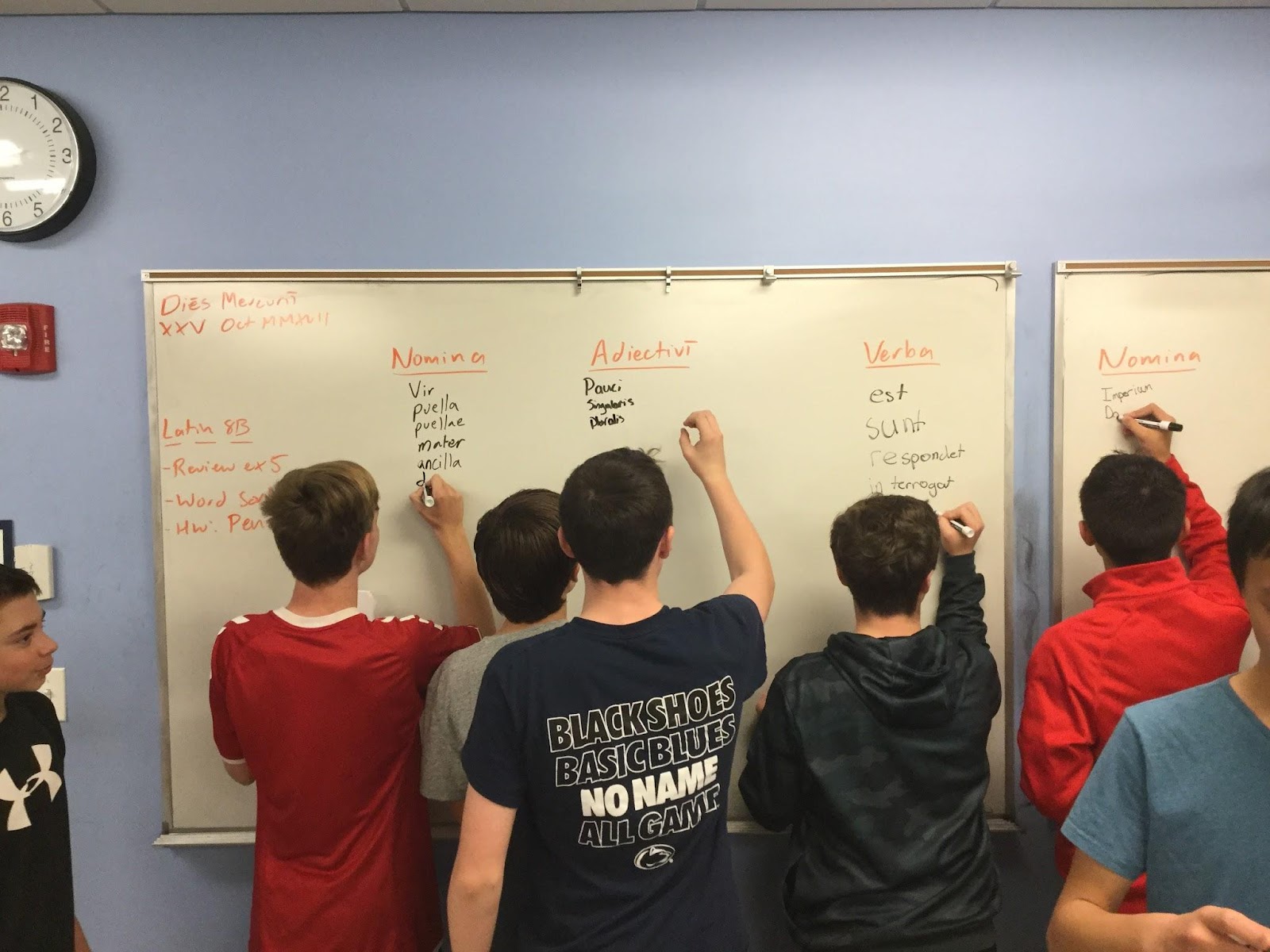
Once the teams agreed on their piles, the students copied their lists into three columns on the whiteboard - NOMINA (Nouns), ADIECTIVĪ (Adjectives) and VERBA (Verbs). The teams then checked each lists for any mistakes.IMG_0129.JPGIMG_0124.JPG

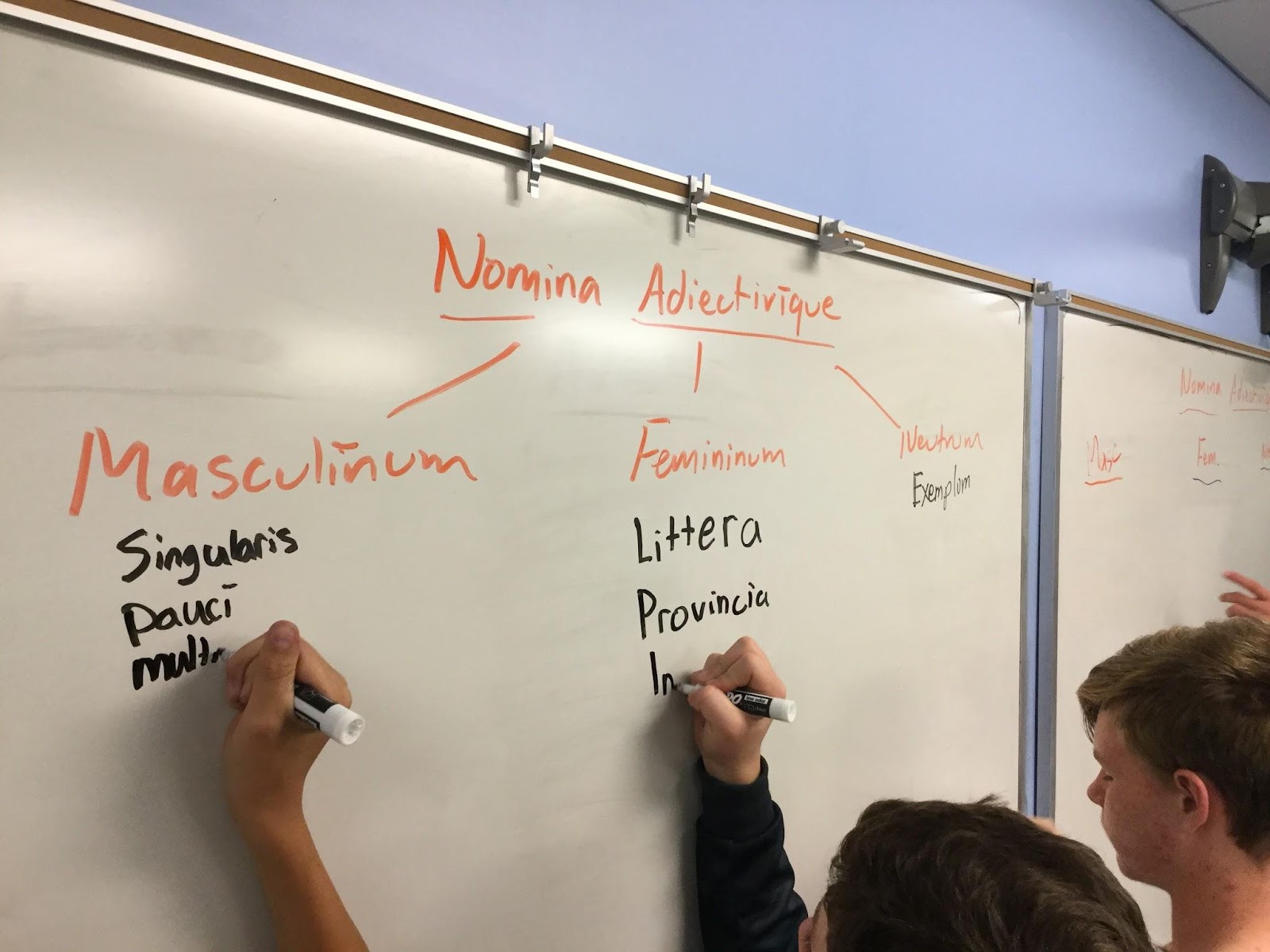
Finally, once the teams agreed on the parts of speech, they had one more task. The students took the nouns and adjectives and separated them by gender. The three new categories for this round were MASCULINIUM, FEMININUM and NEUTRUM.
IMG_0127.JPG