Showing posts with label Catherine McCarthy. Show all posts

Wednesday, February 7, 2018

Day 97 - Writing Effective Arguments - Mrs. McCarthy - BHS Special Ed. Staff

This post first appeared on the Burlington Keys to Literacy Blog

Keys to Literacy offers a great workshop on writing effective arguments, and breaks down the process into manageable chunks to guide students and teachers through the process. After attending the workshop, my co-teacher Rebecca Bernard and I created a writing assignment for our Sophomore English students to argue for or against the United States Travel Ban. First, we had students read an article outlining both perspectives. We had them highlight in different colors, arguments for and those against. Students transferred these ideas onto a planning sheet.
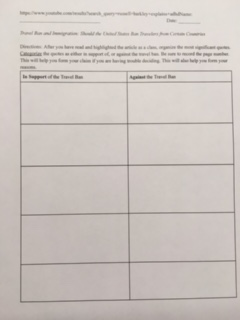

After students have formed their opinions and chosen their position, based on what they have read, we introduced them to the structure of the argument essay.
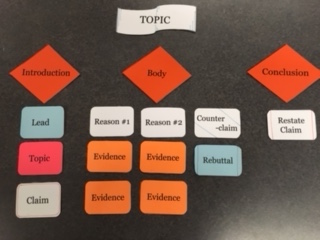

As seen in the photo above, there are three major parts of the essay, just as with analytical writing: Introduction, Body and Conclusion, but instead of the PIE structure, the paragraphs are structured based on reasons and evidence, as well as the opposing point of view, or counter-argument, which is followed by a rebuttal. Students do need encouragement to write their opinion, given we have disallowed it for their analytical writing. 

Below is the link to the assignment and planning sheet:

https://docs.google.com/document/d/1v5n568GWKvAe1X-YbYs2WqWvMpaZ9uXBErPHR9RDhvE/edit


When your students have completed the assignment, the KTL website contains rubrics for argument writing that closely examine the elements needed for an effective essay.

Monday, May 8, 2017

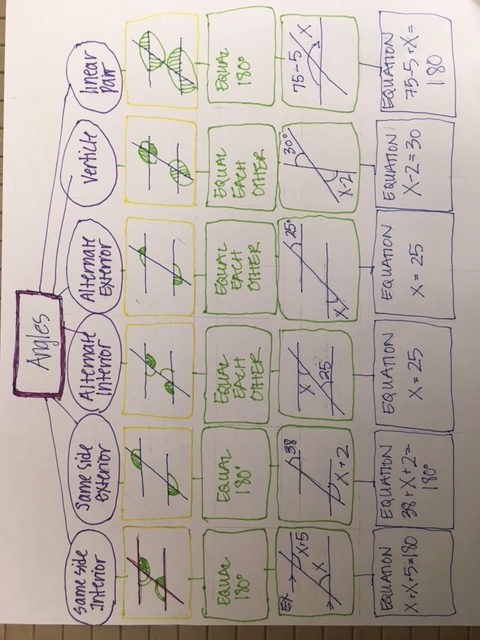
Day 147 - Top Down Webs in Geometry - Mrs. McCarthy - BHS Special Education Dept.


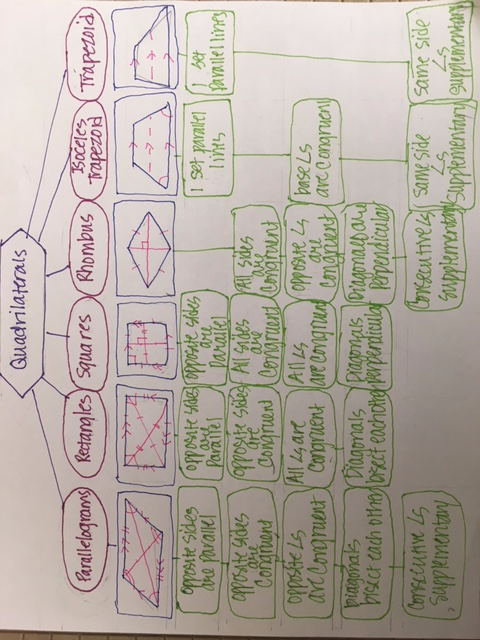
Using top-down webs as both a note-taking and processing tool is beneficial to students in Geometry.  In Geometry, students are challenged to identify the patterns that exist within different shapes and to solve the algebraic equations that are embedded in these figures. When faced with geometric problems, students can struggle to merge their understanding of Algebra with their emerging understanding of the geometric principles they are studying. By encouraging students to create top-down webs which clearly identify the properties of the shapes, students can reference these notes when solving the problems. Furthermore, including models of equations reinforces students’ understanding of how to set up new problems.
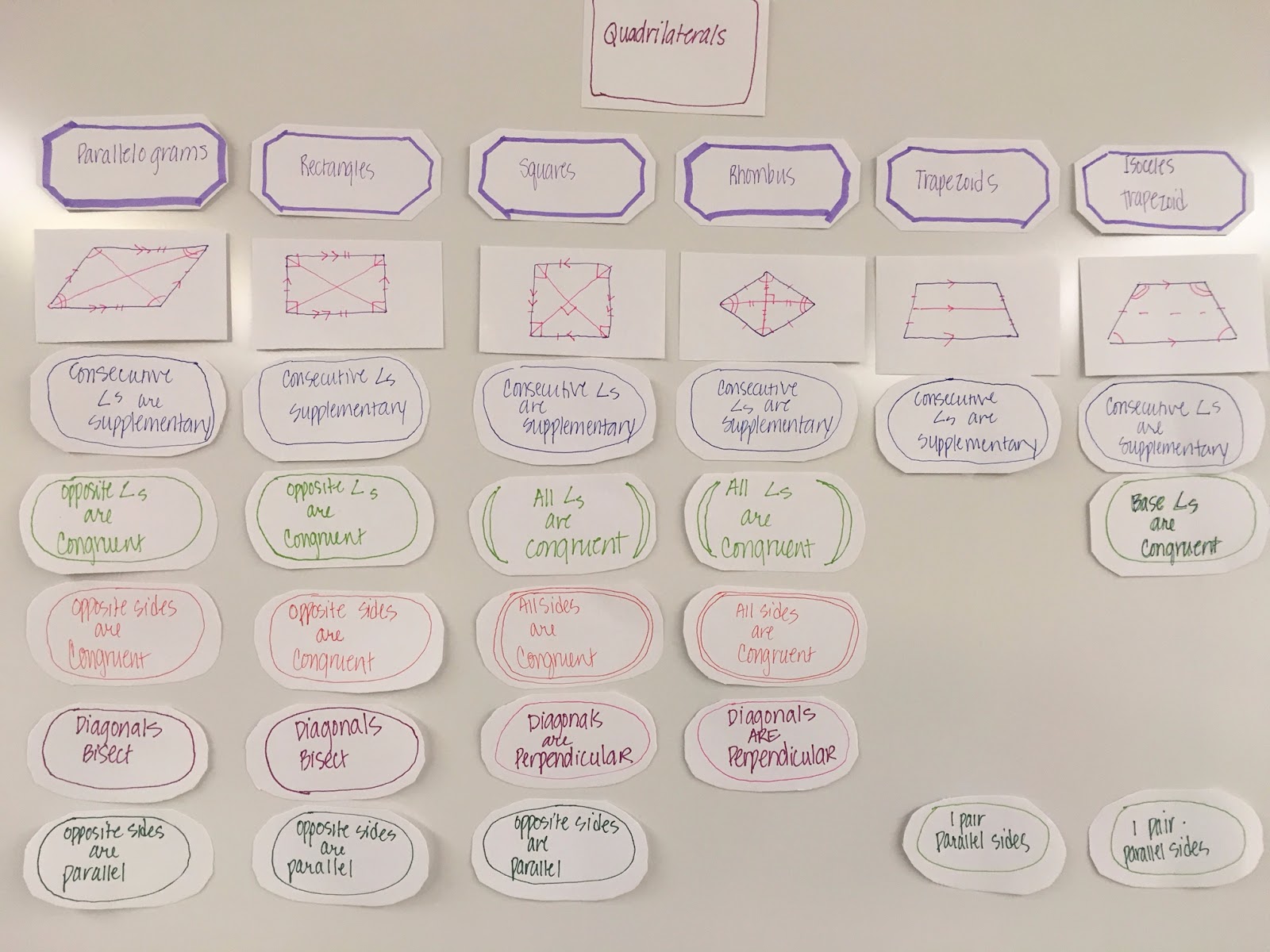
In addition to guiding students through the problem-solving process, top-down webs provide a note-taking method that allow them to compare and contrast and see the relationships between the characteristics of shapes being studied. Including visual depictions of each shape provides an immediate reference for students that reinforces their knowledge. When students are provided with a blank template at the start of the unit, the can add information as they proceed through the unit and immediately begin to see comparisons.
Students can also use these webs as study tools. When the elements of a web are put on separate pieces of paper, the information can be reviewed by building the web from memory to check understanding. The use of both color and pictures helps students identify common elements and differences across shapes.