Tuesday, January 31, 2017

Day 92 - Two-Column Notes in Math - Ms. Mantia and Mrs. MacCurtain - MSMS Math

This post first appeared on our Burlington Keys to Literacy Blog

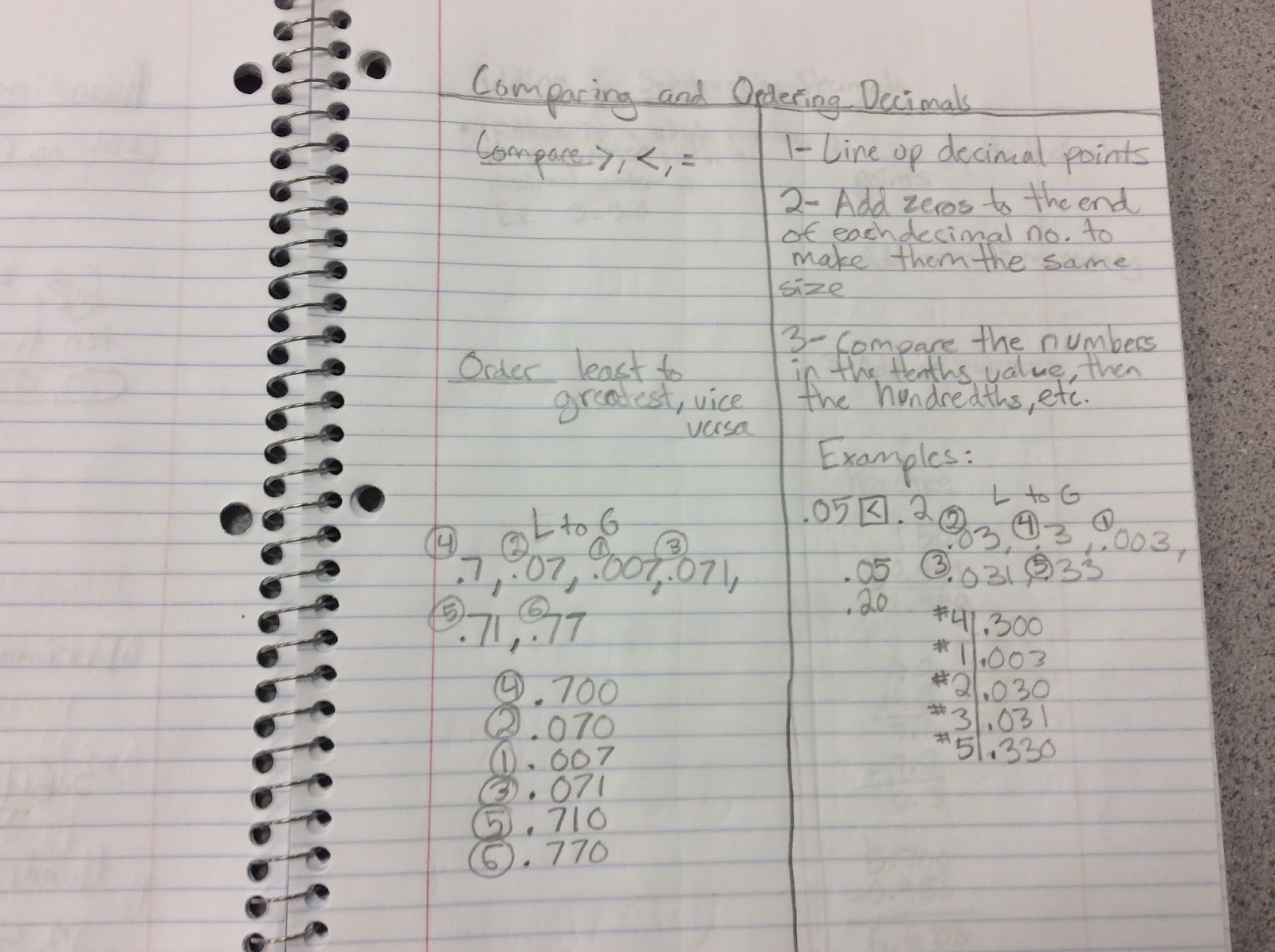
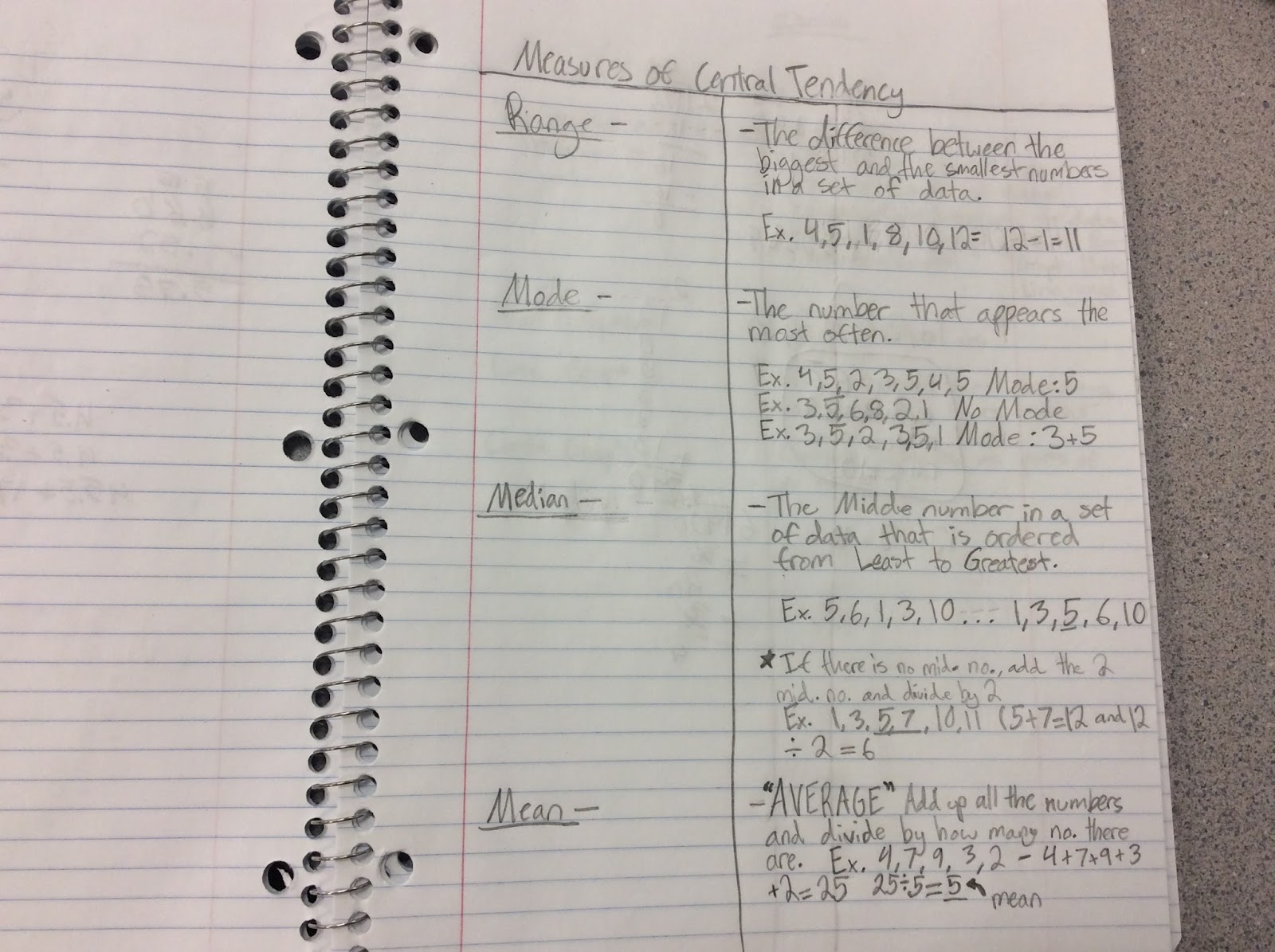
In our math classes we use two-column notes for three different purposes. The first, and the one we use most often, is two-column notes “101.”  We, the teachers, give the notes to the students for them to copy down in their math notebooks.  The notes are either a mathematical process that they need to know, for example, how to compare and order decimals or how to graph the slope of a line.  Or the notes are for math vocabulary that the students need to know in order to perform the process they are learning. Here are a couple of examples.
IMG_1236.JPGIMG_1237.JPG


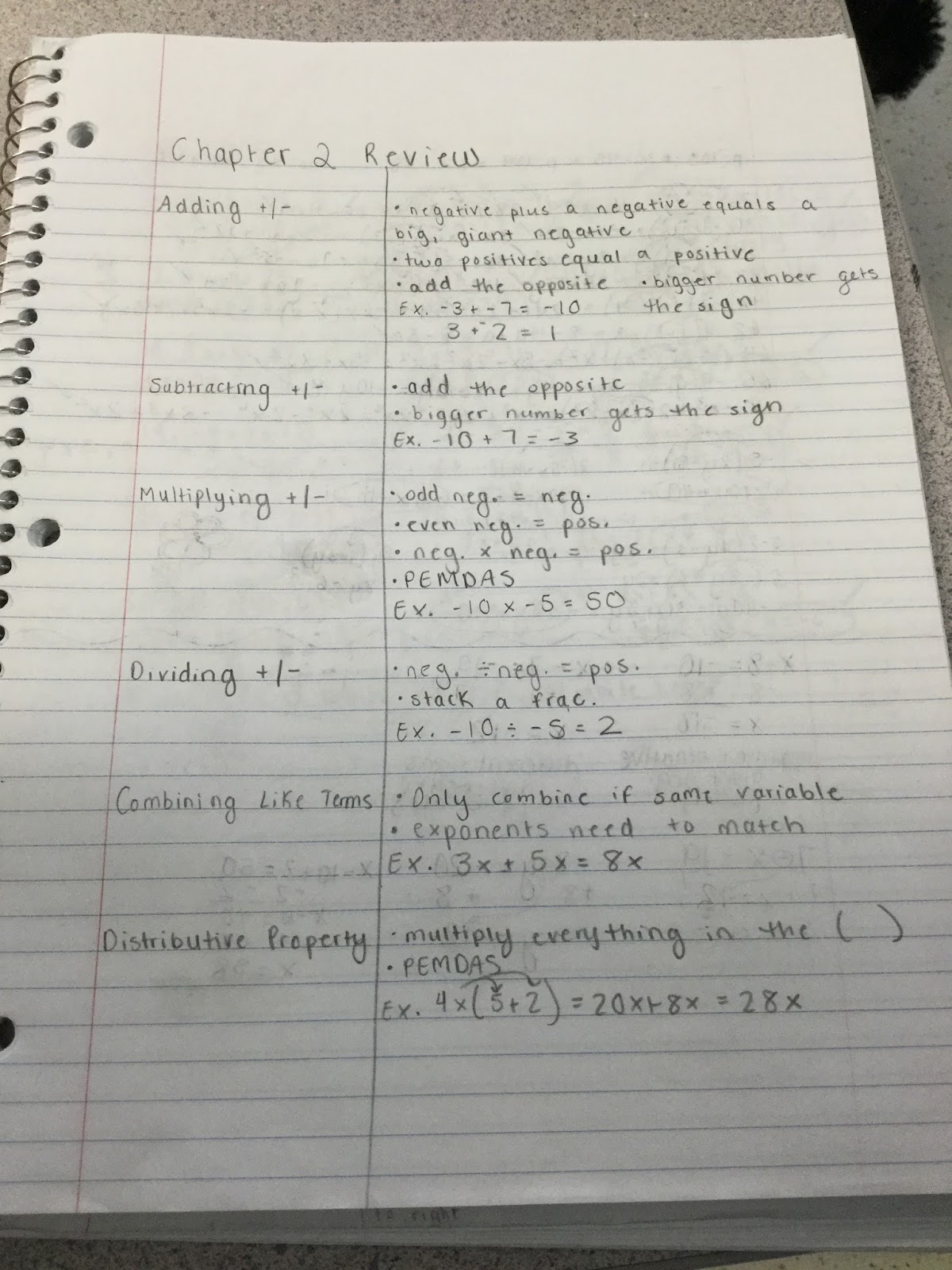
Two-column notes can also serve as a study guide for a quiz or test.  We begin the lesson by brainstorming the main topics from the chapter as a class and writing the topics on the board.  Students then work with partners to write the 2-column notes.  Partners write the main ideas from the class brainstorm in the left column and work together to generate appropriate details for the right column.  In math, these details may include rules, steps, and sample problems for each topic.  At the end of the lesson, we discuss the student-generated 2-column notes as a class.  We remind students to check their own notes and make additions and changes as needed based on class discussion. Here is an example of this.
IMG_0033.JPG


The third way students generate two column-notes is as part of a homework assignment.  We would assign “Read Chapter 3 Unit 1 and write 2-column notes for the main topics.”  We had mixed results the first time we did this.  Some of the notes were exemplary and even color-coded; others were too detailed; others were a total of four lines long.  One of the students asked, “Will you please show us how you would do this before you assign this again?”  This sounded like a valid request.  Rather than wait until next time, we read the section aloud with the students and did a think-aloud of how we would generate the notes based on my reading.  We discussed what would serve as clues for main topics and students suggested “the bold vocab words,” “the headings on the pages,” “the parts labeled Example.”  Sometimes other students would guide the answers and sometimes we would.  Specifically, students agreed that bold vocab words as main topics were a good idea and “the parts labeled Example” were probably better served in the details section of the notes. Here is an example.
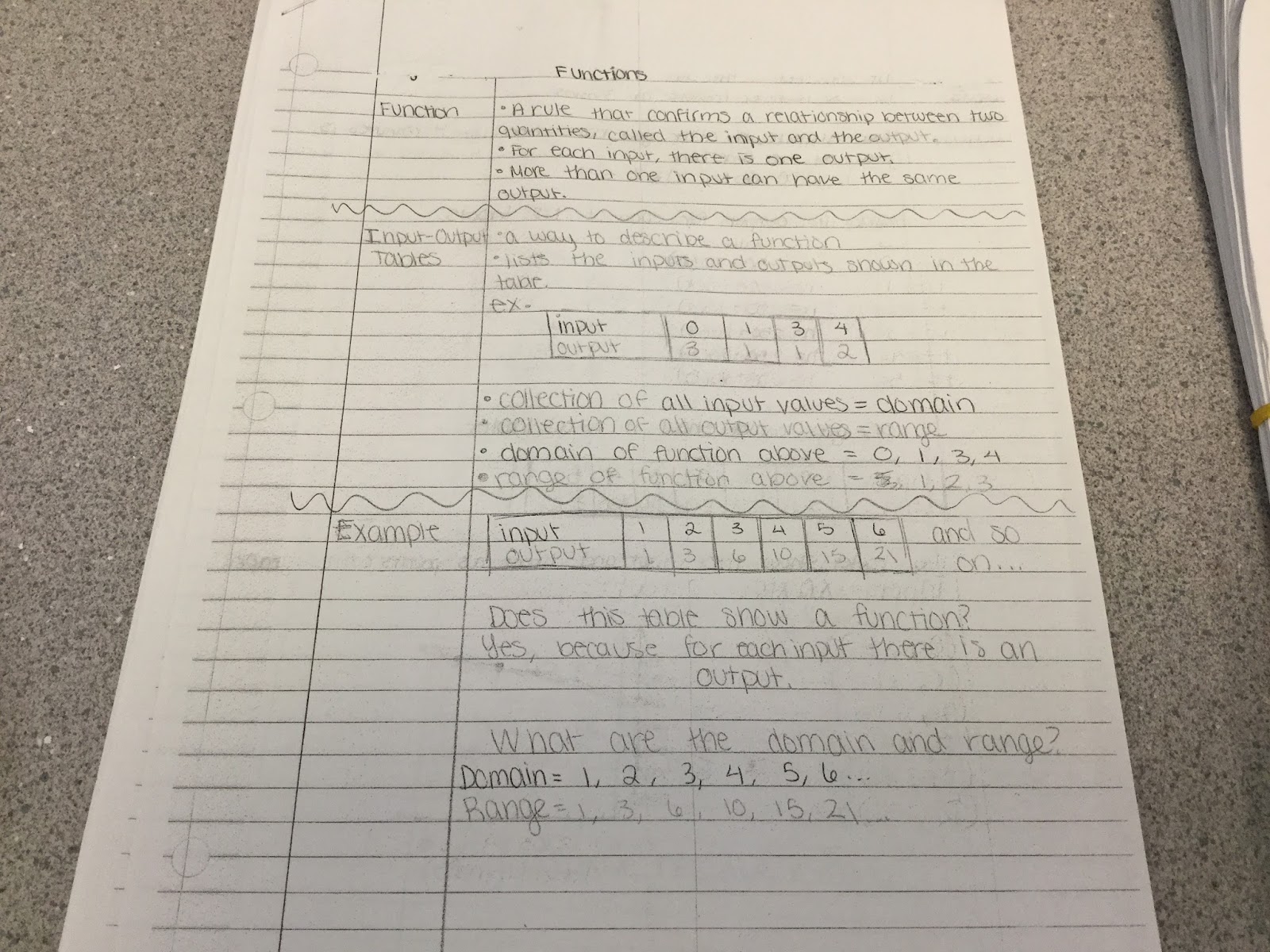
image1.JPG


Overall, we have had great success using two-column notes in our math classes.  As you can see, we use them for different purposes but each method (note taking, vocabulary, study guide, homework) is beneficial in its own way.  Two-column notes have helped our students with organization, remembering material and gaining a deeper understanding of mathematics.  

Monday, January 30, 2017

Day 91 - An Open Letter to Students - Dr. Conti - Superintendent of Schools

An Open Letter to Burlington Students:
It is hard not to hear many adult conversations and see news reports around you regarding the recent restrictions on immigration.  Many people are struggling with questions of belonging.  Some question if everyone belongs and whether we can be safe.  Please be assured that all of you belong in the Burlington Schools.  Our commitment to educating all of you has never been more unyielding and important.
In my opinion, adults simply need to look inside our classrooms and learn from you.  I see classrooms where everyone is accepted regardless of faith, culture, ability, economic standing, and other differences.  You all believe in the best of your classmates and their intentions.  What you may not realize is that these lessons have been at the heart of public schools for a long time.
A part of the answer to the question of who belongs in public school can be seen in the Supreme Court’s decision of Plyler v. Doe (1982).  In Plyler, the Supreme Court determined that children belong in our public schools no matter how the children came to live in a community.  In other words, a child’s immigration status is not relevant.  You are all learners first.  If you live in Burlington, you are welcome in school.  You belong in school.  You are safe in school.  You are loved in school.
Moreover, nearly 75 years prior to the Plyler decision, John Dewey, a great American philosopher, psychologist and educational reformer, said:
“The intermingling in the school of youth of different races, differing religions, and unlike customs creates for all a new and broader environment. Common subject matter accustoms all to a unity of outlook upon a broader horizon than is visible to the members of any group while it is isolated. The assimilative force of the American public school is eloquent testimony to the efficacy of the common and balanced appeal.”
Please know that all of you belong, and together in Burlington, we are creating a broader horizon for everyone.
Thank you, Eric Conti  

Friday, January 27, 2017

Day 90 - Kind Kids Are Cool - Mrs. Hoyt - Pine Glen Kindergarten

This post first appeared on Mrs. Hoyt's Blog


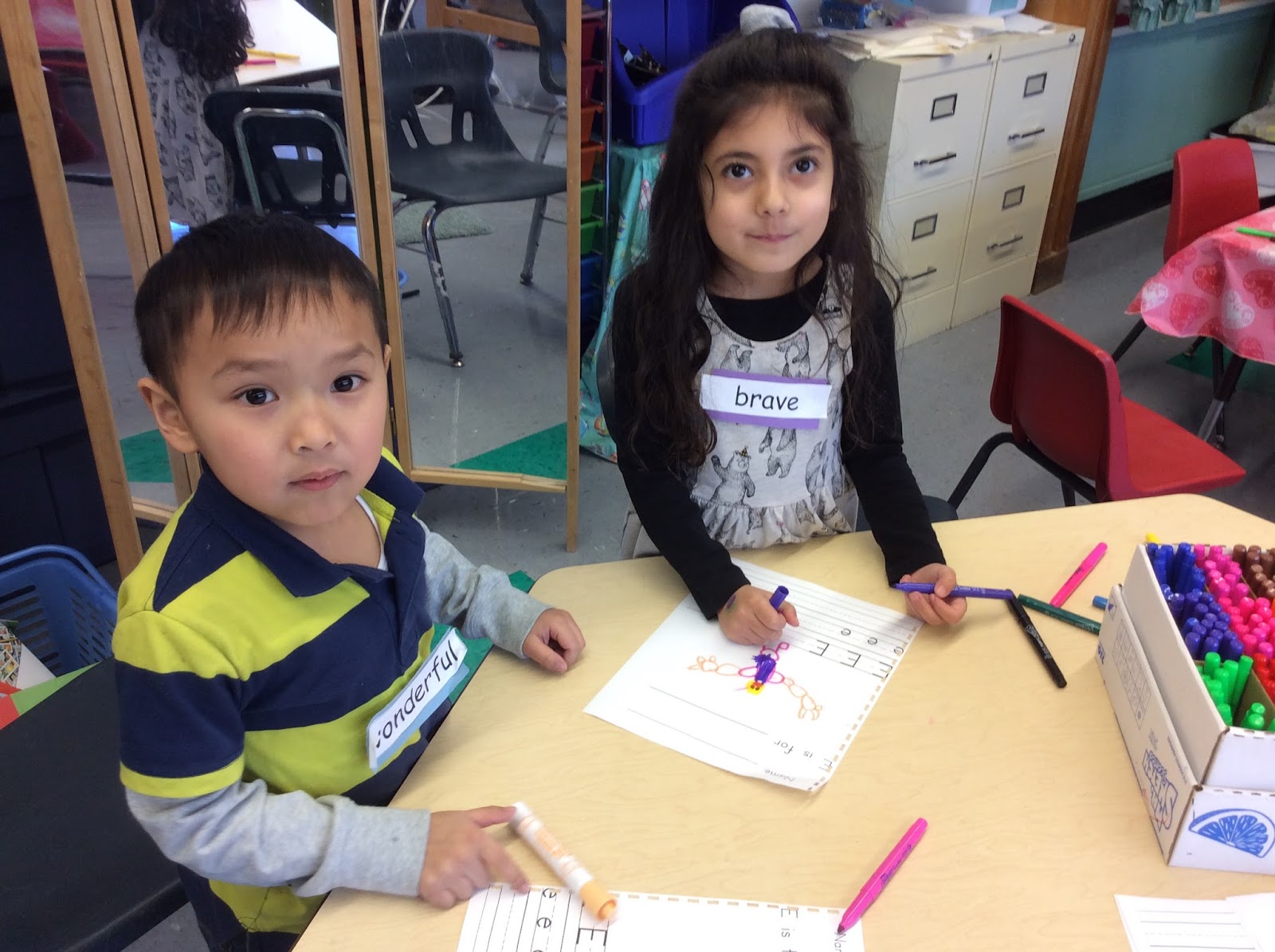
As we prepared to open our class post office we brainstormed all the nice things that we might want to write to friends when communicating via hand-written notes.  This discussion led us to the conclusion that we should always do our best to demonstrate the attributes of good friends.  To help us practice living up to the expectations of good friends we decided to wear the words.  As you can see we are peaceful, kind, respectful, funny, brave, wonderful and smiling!


They wore their names as they worked on their dictionaries.


Students continued to smile as they worked on their procedural posters.

We were thoughtful and respectful during morning meeting on the rug.

And we were cheerful while reading our Scholastic magazines.


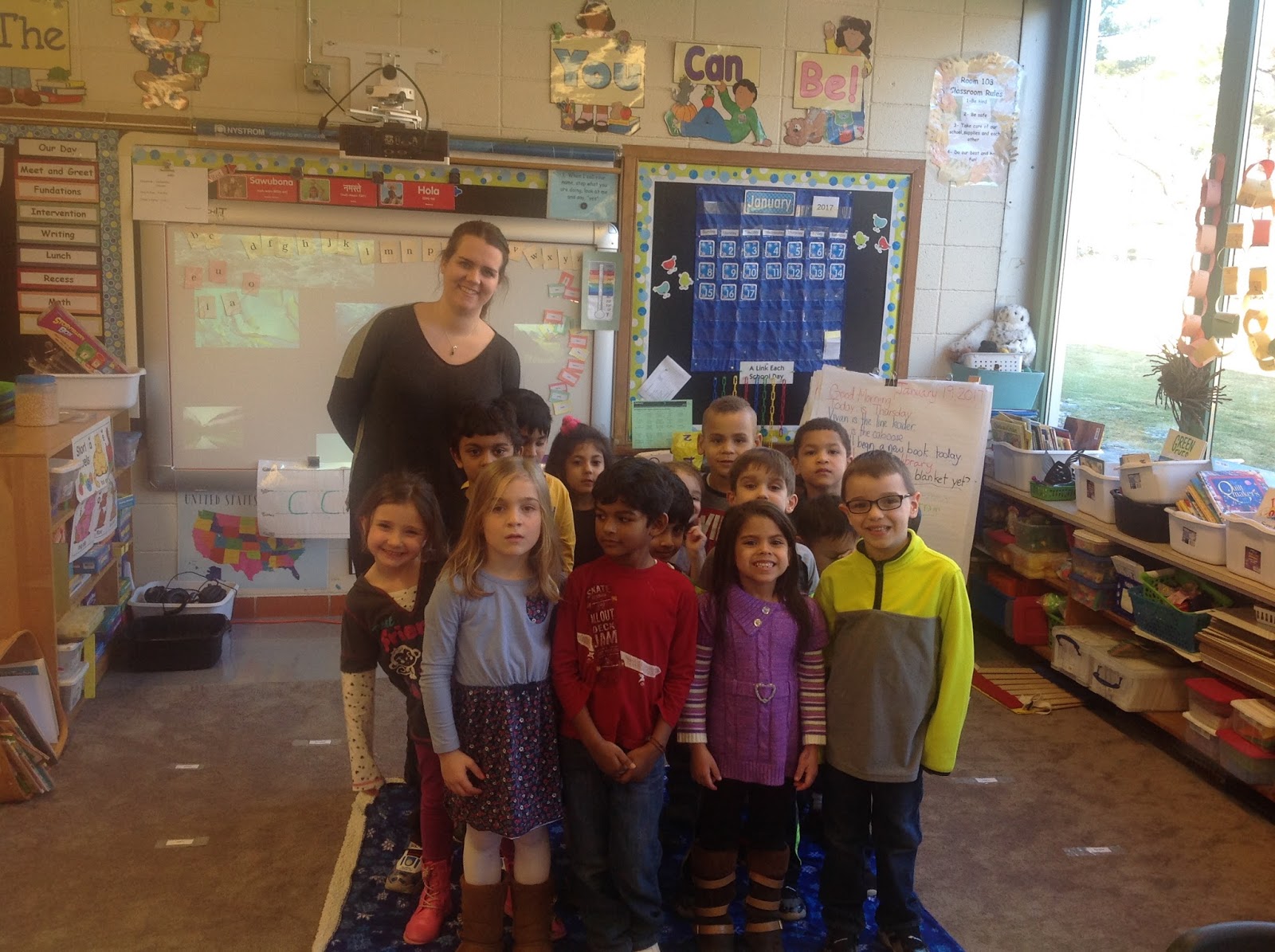
We continue to be all smiles as we share our blankets, quilts and afghans.  


The highlight of revealing each person's treasure is the opportunity to measure the area.  We have loved measuring with our bodies!


Thursday, January 26, 2017

Day 89 - Nature Paintings by Drawing and Painting Students - Ms. Chang - BHS Art Dept.

This post first appeared on Ms. Chang's blog

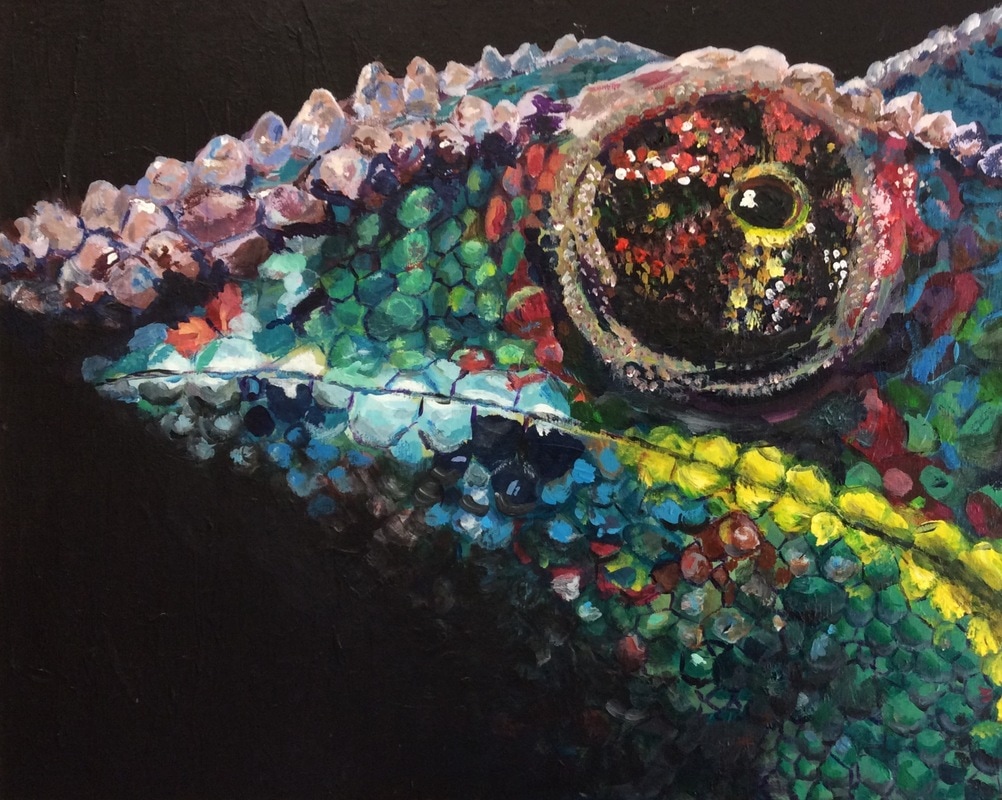
Students in the Drawing and Painting class created large acrylic paintings of nature. Click below for the assignment details:

Nature Painting


Picture
By Gati Aher, Class of 2019


Picture
by Sophia Lupo, Class of 2019


Picture
By Kassidy Kirchner, Class of 2017


Picture
By Quentin Inglis, Class of 2018

Wednesday, January 25, 2017

Day 88 - Homemade Fine Motor Fun - BECC Therapists

Store bought toys can be lots of fun but don’t underestimate the fun you and your little one can have with items you already have in your home.  Below is a list of household items and easy activities that can be used both for fun & fine motor skill building!

photo via http://tinkerlab.com/rainbow-play-dough/
Materials
  • Toothpicks
– Build shapes and towers with toothpicks using mini marshmallows
-Turn over a colander and feed the toothpicks into the small holes

  • Cheerios/fruit loops
-Use cereal as your “beads” to practice bead stringing.  Use pipe cleaners, string or coffee stirrers to string the cereal onto

  • Uncooked pasta
-Use ziti or penne as “beads” to practice stringing
-Use smaller pasta such as elbow macaroni  to glue on to pictures or outlines to make a textured mosaic
-Glue macaroni onto large letter or shape outlines to practice letters and shape recognition while developing fine motor skills

  • Dried beans or rice
-Place dried rice or beans on a tray or shallow container.  Hide small toys or buttons and have your child try to find them with their finger tips or use small tongs or strawberry hullers to pull them out

  • Shaving cream or whipped cream
-Enjoy some sensory play time…..place shaving cream or whipped cream on a tray.  Practice “drawing” line strokes, shapes or letters in the cream, with your fingertips.

  • Sponges 
-Cut sponge into small, 1/2” squares.  Use 2 small bowls, one with water and one empty.  Challenge your child to dip the sponge squares into the the water, then squeeze them out (using finger tips) into the empty bowl.  Coloring the water with food coloring may make it more fun!
-Use small sponge squares to sponge paint a picture.  
  
  • Flour, salt, oil, food coloring, cream of tartar

-Make playdough!  Follow this link from tinkerlab.com for a great homemade playdough recipe.  
Both the process of making the playdough and playing with the playdoh will be great for hand strengthening.

Tuesday, January 24, 2017

Day 87 - The Eggs Are Coming - Mrs. Jefferson - Francis Wyman Grade 1


Wendy Pavlicek from the Science Center came today to teach the children about chickens, roosters and eggs. Last Friday each 1st grade classroom got an incubator to plug in to prepare for the arrival of our eggs that have already started the incubation process at the Science Center. They will be delivered to us on day 19 or 20 of the 21 day cycle so the children will actually see them hatch. It's a great learning experience for the kids.


Monday, January 23, 2017

Day 86 - Heroes Assembly - Mr. Daley - Fox Hill Grade 4

This post first appeared on Mr. Daley's Blog 

This past Friday, Fox Hill held a school-wide assembly to celebrate and recognize heroes. At this "Heroes Assembly," students at all grade levels spoke about what makes a hero, how we can all be every-day heroes, and how to give thanks to today's and yesterday's heroes throughout our community, nation, and the world.

Grade 4 students all identified someone who is a hero to them, and more importantly why and how that person is a hero to them. Five Grade 4 students read their hero essays at the assembly. Each student performed beautifully in reciting his and her heartfelt messages.

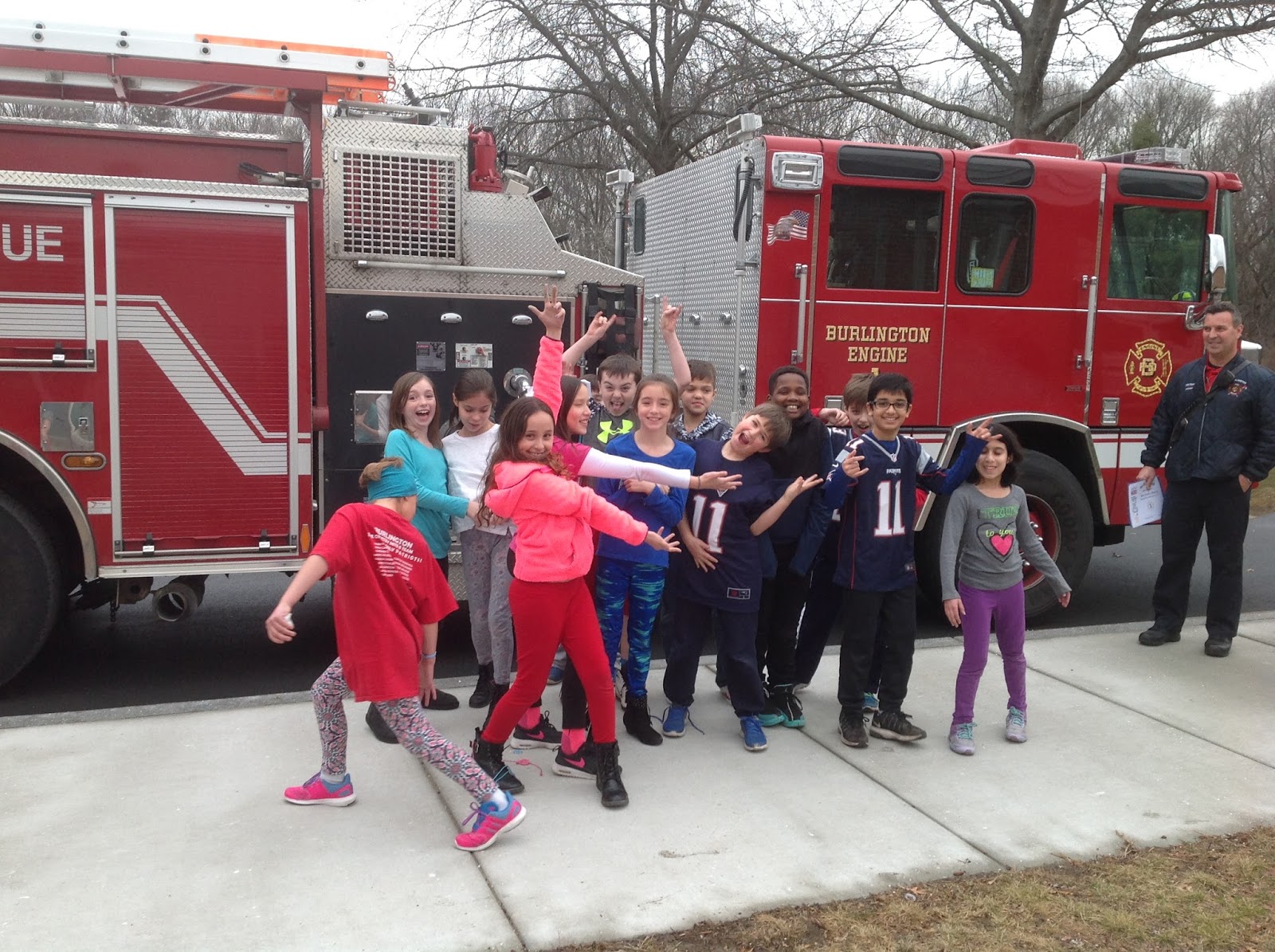
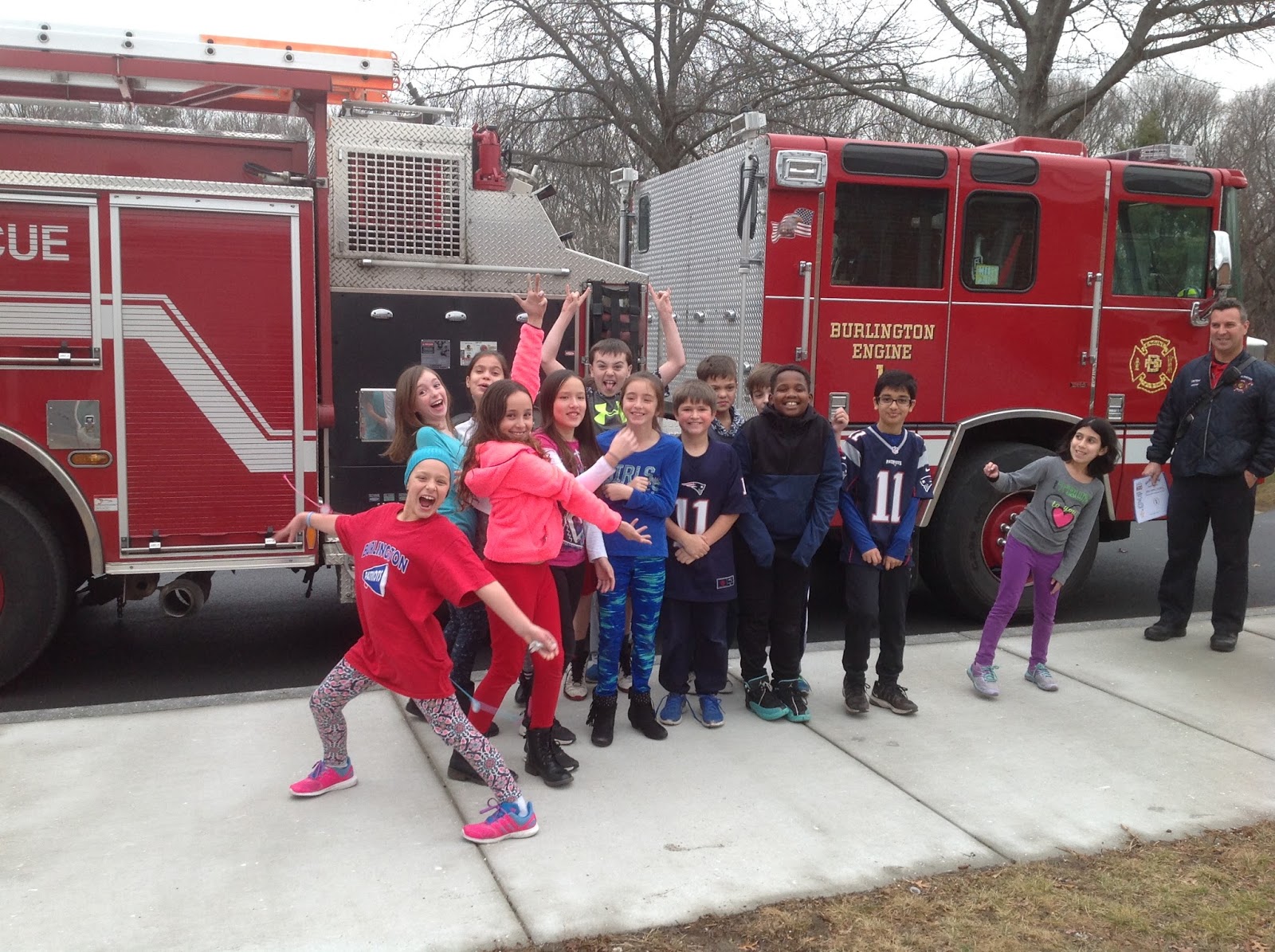
Below is a video of those students reading their essays. Prior to the video, though, are some photos from (and after) the assembly. Grade 5 students asked local firefighters and police to attend the assembly as their heroes. All students had an opportunity following the assembly to "ham it up" in front of the fire trucks! A great time was had by all!


Friday, January 20, 2017

Day 85 - January Social Skills Lesson - Teaching Tolerance - Memorial School Guidance Counselors


Teaching Tolerance
It is OK to be different

We will be having discussions with each classroom about differences, diversity and what a community is. Students will learn how a diverse community makes our classroom stronger.  

Grades K-2:
We will be teaching about diversity. In each classroom, we will have a discussion about what it means to be different. We will also talk about communities and which communities we belong to. Students will learn that it is okay to be different because diversity can make our community stronger as we all come from different backgrounds. 

We will be reading the story "It's Okay to Be Different"

After the read aloud, students will participate in a movement activity called "The Warm Wind Blows". We will not only be learning about the differences that we can see with our eyes but we will also be focusing on differences we can't see. Students will learn how we can celebrate these differences in the classroom and at school. 

Some examples:
"The warm wind blows if you you have traveled to another country"
"The warm wind blows if you have a brother or a sister"
"The warm wind blows if you were born outside of Massachusetts"

Grades 3-5:


Students will learn about the terms diversity and community. We will discuss how diversity is important in a community. Students will share ways they are different from one another and how we can celebrate these differences in our school and classroom communities.  As a class, we will talk about how being a diverse community can make our classroom stronger.

Students will participate in a human scavenger hunt to learn more about their classmates and the diversity of their classroom community. The activity is called, "Find Someone Who...". Students will need to find someone in the room who applies to the question being asked. 

Some examples are:
Find someone who speaks more than one language.
Find someone who has a weekend tradition.
Find someone who has traveled to another country. 

Students will then share and discuss something they have learned about a classmate. We will end the lesson with a few final thoughts about how being different is okay and we will encourage students to celebrate the things that make them who they are! 

Thursday, January 19, 2017

Day 84 - Formulas, Formulas, Formulas - Mrs. Lynch - Francis Wyman Grade 5

This post first appeared on Mrs. Lynch's Blog


Formulas are

Fancy


As we finished traditional division last week and explored spreadsheets, it seems time to consider the wide world of formulas. To calculate grades individually, we divided the points earned by the points possible. To calculate the average, we added up all of the scores and divided by the amount of tests. Where might you find other data to break down? Tell me a story with real data. Show me your formula to solve. You must have an even amount of data. Your question must end like this: What is the mean, median, mode and range? Is there an outlier? What is it? When calculating the mean and median, be sure to write out the formula equation.

I entered Mrs. Lynch's math class at the beginning of the year. So far we have had 6 math tests. I received these percentage grades. 95, 89, 72, 80, 65 and 91. What is the mean, median, mode and range? Is there an outlier? What is it? When calculating the mean and median, be sure to write out the formula equation.

Answer

Mean: 82%

95+89+72+80+65+91 = 82
               6

Or

(95+89+72+80+65+91)/6 = 82

Median: 84.5%

80+89 = 84.5
    2

Or

(80+89)/2 = 84.5

Mode: No data is repeated so there is no mode.

Range: 95-65=30

Outlier: 65 could be an outlier, but there isn't a great deal of data. It is the furthest removed from the rest of the data. And it is the only grade that is a D. 

Wednesday, January 18, 2017

Day 83 - Mr. Marino’s Science Show Pilot - Dr. Conti - Superintendent of Schools

This post first appeared on Dr. Conti's Blog

Mr. Marino’s Science Show Pilot provides a glimpse into his middle school classroom.  What a great example of engaged learning.   Thank you Mr. Marino.

Our emphasis continues to be on creating engaging instruction across all levels of the district.  Mr. Marino’s efforts well represent the efforts of all of our talented teachers.  The planning and preparation of creating engaging lessons and opportunities for personalized learning can often go unrecognized.  In other words, like all talented professionals, our teachers make this work seem effortless.
A teacher’s time with students is only a small part of the job.

Tuesday, January 17, 2017

Day 82 - Students Doing Their Best on the Test! - Memorial ELL Staff

This post first appeared on the Memorial School ELL Blog

We hope 2017 is off to a great start! Students continue to impress us with their hard work. In December, Kindergarten students learned about sea creatures and their features. Meanwhile, students in the upper grades studied various holidays around the world.

This month, all students will be taking the ACCESS test which measures their English proficiency in speaking, listening, reading and writing. We have been so proud of students who have already completed the assessment and look forward to having more students "show what they know" later this month.


Here are some pictures of students' recent activities.


4th grader Yali presenting to his class about Hanukkah. 
3rd grader  Aron building a circuit and explaining the steps. 


2nd graders learning about Kwanzaa 
2nd grader Julia demonstrating how to edit sentences. 
2nd graders writing facts about the holidays. 


K students writing on display