Showing posts with label Memorial School Guidance. Show all posts

Friday, February 16, 2018

Day 103 - February 2018: Self Control - Mrs. Alper - Memorial Guidance


Students will be learning about self-control this month and why it is important to maintain control over their words and their actions. We are always experiencing different feelings and sometimes it is harder to control your mind and your body.
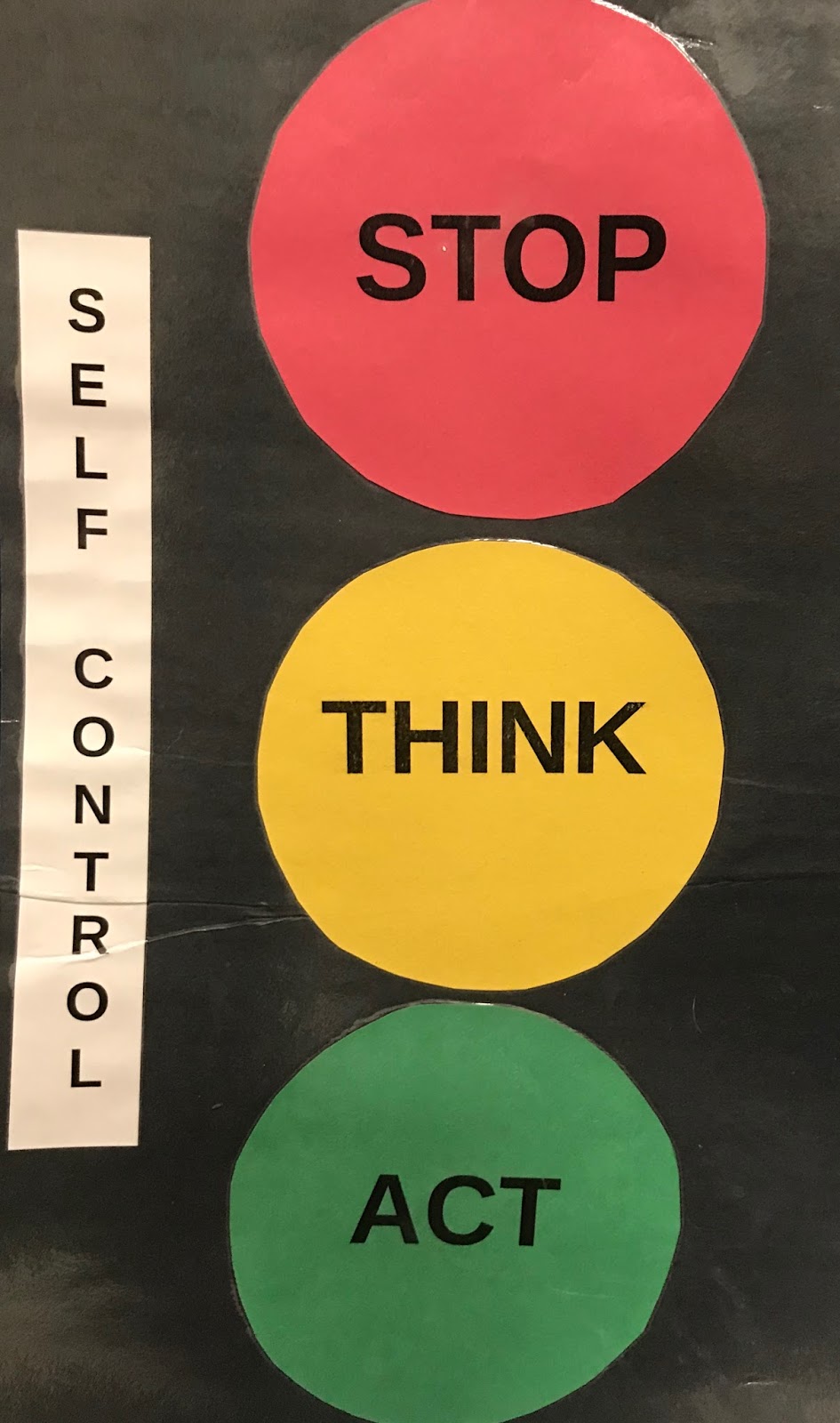
Students were taught to STOP, THINK, and then ACT. Sometimes students will act without thinking about how their words or their actions affect other people.

First, students will have a discussion about self-control and what it means using prior knowledge and new information. Then students will practice having self-control using a bubble machine. 

  1. We will turn on the machine and the students will be able to pop as many bubbles that come near them. 
  2. We will turn on the machine and students will have to maintain self-control and not pop a single bubble. 
After the students practice using self-control, we will read the story 
You Get What You Get 
by Julie Gassman. 
This story is about a squirrel named Melvin who throws a fit when he doesn't get what he wants. At school, he has to follow the rule "You get what you get and you don't throw a fit". He is able to maintain his self-control at school but still thinks it is ok to throw a fit when he doesn't get what he wants at home. He quickly realizes that rule is just as important at home too when his sister gets upset when she doesn't get what she wants. 

After reading the story we will also talk about the importance of maintaining self-control with your words too. Your brain acts like a filter and your words need to go through the social filter to determine whether it is a thought that you can say out loud or a thought that should stay in your filter and you should only think it. 
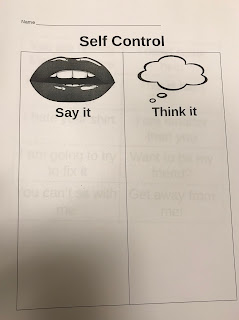
Students will be given examples of thoughts they can "say" and thoughts that they should only "think".

Then students will partner up and work on a worksheet where they will have to put each "thought" in the column it belongs. 
SAY IT               or                 THINK IT


Our goal is for students to continue to practice self-control and to be more aware of their words and actions and how they impact their social settings. 

Thursday, January 25, 2018

Day 88 - Having the courage to be who you are - Ms. Flaccavento - Memorial School Guidance


This month students will be reading "Spaghetti in a Hot Dog Bun" written by, Maria Dismondy.   This is a great story that shows how to have the courage to treat others the way you want to be treated. Lucy's papa teaches her that “Not everyone likes the same things, Lucy. It doesn’t mean one person is right or wrong. We’re all different. What a boring world it would be if we were all exactly the same?” In the book, Lucy accepts herself as being different and learns to celebrate those differences.  This story empowers children to always do the right thing and find the courage to stand up for yourself when someone is being unkind.
As a class, we will discuss how Lucy and Ralph are similar and different. A discussion will be about not being the same as another person doesn't mean you have to change who you are or what you enjoy. Students will learn that having the courage to be you is important and special.


Students will partner up and compile a list of traits on how they are similar and different from each other. This activity includes topics such as diversity, tolerance and acceptance while they learn more about other classmates and community.

Friday, March 10, 2017

Day 113 - March Social Skills Lesson - Bullying and Cyber-Bullying - Memorial School Guidance Counselors


Bullying and Cyber-bullying
"Sometimes it just takes ONE"

Grades K, 1 and 2:
Students will be listening to the story One by Katherine Otoshi.
Image result for one by kathryn otoshi
One is a story about colors and numbers. Blue is a quiet color and Red is a hothead who likes to pick on Blue. Yellow, Orange, Green, and Purple don’t like what they see and don't know what to do to stop it. When no one speaks up, things get out of hand. Red gets bigger and bigger. Then, One comes along and shows all the colors how to stand up, stand together, and count. Sometimes it just takes one voice to make a difference and make every one count.

After listening to the story, the students will break up into groups. Each group will be assigned a color and they will discuss what they would do if they were that color in the story. They will also talk about what they could do to make a difference and stand up for one another.

Students will go back to their seats and write one sentence on how they can make a difference.
Image result for one by kathryn otoshi

Grades 4 and 5: Cyber-bullying
Students will be reviewing what they have already learned and know 
about bullying.
What is Bullying?
Bullying is the repeated use by one or more students [aggressor(s)] of a written, verbal or electronic expression or a physical act or gesture or any combination thereof, directed at a target that: (i) causes physical or emotional harm to the target or damage to the target's property; (ii) places the target in reasonable fear of harm to him/herself or of damage to his/her property; (iii) creates a hostile environment at school for the target; (iv) infringes on the rights of the target at school; or (v) materially and substantially disrupts the education process or the orderly operation of a school. For the purposes of requirements related to this law, bullying shall include cyber-bullying.
Bullying Criteria (RIP):
  • Repeated
  • Intentional (i.e. harming someone else on purpose)
  • Imbalance of Power (2 against 1, difference in age, size, ability)

After we discuss our previous knowledge on bullying, we will introduce Cyber-bullying.


DON’T BE MEAN BEHIND THE SCREEN!

  • Cyber-bullying is a difference of power or strength between the perpetrator and the target and this behavior takes place through technology.
  • Some interactions on social media can be positive but some could be very hurtful and unkind.
  • Some studies have shown that people are more likely to be unkind through social media because you can’t see or hear people so it’s easier to pretend we don’t see what’s going on.
  • Remember that people we talk to and play with online are real people. Think what you would say if they were really sitting next to you.
  • Online communication can be recorded and shared, we don't know who and how many people will see anything we do.
  • It is hard to to tell if someone is just joking, or hard to tell if a joke you’ve made  has gone too far and really hurt someone. Has that ever happen to anyone?

After the video, students will break up into groups. They will answer the following questions:
  • How is talking to people online (video games, social network, texting, Instagram, Facebook, email, etc.) different than talking to people face to face?
  • How can we stop Cyber-bullying?
Ticket to Leave
How is talking to people online (through video games, social network, texting, Instagram, instant messaging) different from talking to people face to face?
Online vs. Offline

Helpful Information:


Friday, January 20, 2017

Day 85 - January Social Skills Lesson - Teaching Tolerance - Memorial School Guidance Counselors


Teaching Tolerance
It is OK to be different

We will be having discussions with each classroom about differences, diversity and what a community is. Students will learn how a diverse community makes our classroom stronger.  

Grades K-2:
We will be teaching about diversity. In each classroom, we will have a discussion about what it means to be different. We will also talk about communities and which communities we belong to. Students will learn that it is okay to be different because diversity can make our community stronger as we all come from different backgrounds. 

We will be reading the story "It's Okay to Be Different"

After the read aloud, students will participate in a movement activity called "The Warm Wind Blows". We will not only be learning about the differences that we can see with our eyes but we will also be focusing on differences we can't see. Students will learn how we can celebrate these differences in the classroom and at school. 

Some examples:
"The warm wind blows if you you have traveled to another country"
"The warm wind blows if you have a brother or a sister"
"The warm wind blows if you were born outside of Massachusetts"

Grades 3-5:


Students will learn about the terms diversity and community. We will discuss how diversity is important in a community. Students will share ways they are different from one another and how we can celebrate these differences in our school and classroom communities.  As a class, we will talk about how being a diverse community can make our classroom stronger.

Students will participate in a human scavenger hunt to learn more about their classmates and the diversity of their classroom community. The activity is called, "Find Someone Who...". Students will need to find someone in the room who applies to the question being asked. 

Some examples are:
Find someone who speaks more than one language.
Find someone who has a weekend tradition.
Find someone who has traveled to another country. 

Students will then share and discuss something they have learned about a classmate. We will end the lesson with a few final thoughts about how being different is okay and we will encourage students to celebrate the things that make them who they are!