

Showing posts with label Patrick Larkin. Show all posts

Friday, January 26, 2018

Day 89 - A Trip To Lowell Mills With Memorial Third Graders - Asst. Superintendent Larkin

This post first appeared on Asst. Superintendent Larkin's Blog

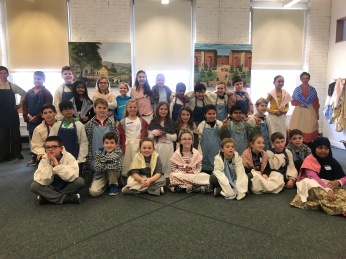
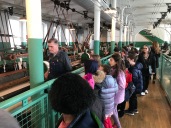
I was thrilled to have the chance to accompany the Memorial third graders on their annual field trip to Lowell Mills yesterday.  I had a great time learning about the history of the textile mills that operated along the Merrimack River canal.
We had an opportunity to learn about the construction of the mills and the development of the surrounding area in the early 19th Century. In addition, we got to see the different roles that men and women would have had both on the farm and at the mills. It was a definite eye-opener to see the relentless schedule of the Lowell Mills Girs who stayed 5 or 6 to a small room and worked from morning until night with few breaks.
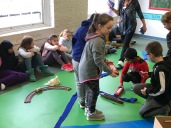
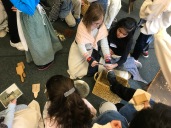
Finally, we ended our visit with a firsthand experience picking cotton seeds out of cotton. After spending some time developing their own tools to pick out the seeds, they all got a chance to spin the wheel on the Cotton Gin.
The students in Mrs. Kippenberger’s and Mrs. Ferullo’s classes were a joy to spend the day with. Thanks again for the invitation!

Wednesday, November 29, 2017

Day 57 - Should We Ban Technology In Classrooms and Meetings? - Asst. Superintendent Larkin

IMG_3364
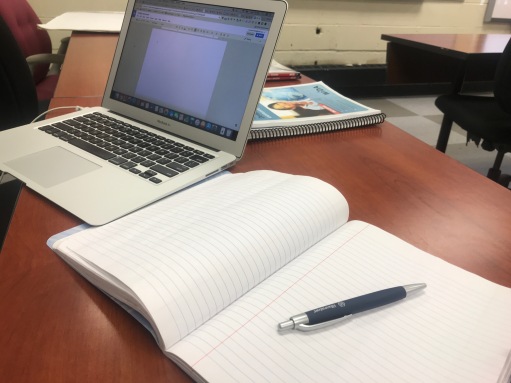
Last Tuesday’s New York Times had an article on the downside of taking notes on a laptop.  The piece, Laptops Are Great. But Not During a Lecture or a Meetingwas written by University of Michigan Professor Susan Dynarski who bans electronic devices in her classroom.  Dynarski cites research from Princeton, UCLA and a few other schools where students who were allowed to take notes electronically performed worse than students who took notes with a pen and paper.
A follow-up post on The Verge yesterday gave a great summary of the article. I especially liked the conclusion:
Writing things by hand is becoming less common as gadgets and speech recognition software continue to replace pen and paper, but it’s long proven that handwriting improves motor skills, memory, and creativity. So even though note taking with a laptop might be faster, you might want to think about how much information you’re retaining.
My final thoughts on this center around the idea that we need to take away the opportunity for the individual to make the choice on which method works best.  As students get to the later stages of high school and move on to college, shouldn’t they have the chance to choose the tool that works best for them?  If people become aware that their productivity drops when they take notes on a device, will they still choose to work in the same manner? Isn’t the process of figuring out what works and what doesn’t a critical part of the learning process?
I can’t help thinking about the Framework for 21st Century Curriculum and Assessment developed by the National Council of Teachers of English (NCTE).  This framework includes “students’ self-evaluation and reflection on process and product integrated into the learning process and contributing to students’ continued growth.”
In short, we need to be careful that banning is not our default reaction. We will teach students a great deal if we help them be more introspective about what works best for them.

Tuesday, January 3, 2017

Day 73 - Three Great Resources To Help Students Fight Off Fake News - Asst. Supt. Larkin


Screen Shot 2016-12-16 at 3.58.18 PM.png
In my previous post on the topic of Fake News, I mentioned that Fake News is nothing new. There have always been individuals and organizations that have tried to influence people by presenting them with stories that stray from the truth. While these stories vary in the degree of factual information they contain, the more important question regards the ability of the reader to delve into these articles and blog posts and pull out where things veer from fact to fiction.  The National Council of Teachers of English (NCTE) highlights the following skills for students in its 21st Century Literacies Framework:
  • Students in the 21st century must be able to take information from multiple places and in a variety of different formats, determine its reliability, and create new knowledge from that information.
  • Students in the 21st century must be critical consumers and creators of multimedia texts.
In order to attain these skills, teachers are encouraged to reflect on the following questions:
  • Do students analyze the credibility of information and its appropriateness in meeting their needs?
  • Do students use information to make decisions as informed citizens?
  • Do students strive to see limitations and overlaps between multiple streams of information?
  • Do students analyze and evaluate the multimedia sources that they use?
While the bulleted items above are just an abridged look at the skills and questions that are outlined in NCTE's Framework 21st Century Literacies Framework, an equally important issue is in regards to the resources that are available for students to utilize to determine the credibility of sources of information that they come across. The resources below are a few of the ones that I have come across to help support students in this complicated task:
  1. Truth, truthiness, triangulation: A news literacy toolkit for a "post-truth" world  - (A great post from Joyce Valenza on School Library Journal's Website)
  2. FAKE NEWS vs. REAL NEWS: How to Determine the Reliability of Sources - (Website from Northern Essex Community College

Tuesday, January 19, 2016

Day 86 - Wondering In Mrs. Fitzpatrick Class At Pine Glen - Assistant Superintendent Larkin

This post first appeared on Assistant Superintendent Larkin's Blog

During a visit to Pine Glen Elementary this week, Mrs. Fitpatrick shared with me some of the work her students are doing on their "I'm Wondering" projects.  All of the students have an opportunity to research and write about anything that they would like to learn more about during intervention/extension time.  On the wall of the classroom there are pictures of the students with what they are working on during their "I'm Wondering" time.  


In addition, some of the students have posted QR codes on the wall which link to publications that they have created to document what they have learned.  Check out a couple examples below from Cooper and Emma.


Wednesday, May 21, 2014

Day 158 - I Am Right! A Follow-up To My Rant About Online Reading - Patrick Larkin, Assistant Superintendent

The future of books
The future of books (Photo credit: Johan Larsson)
On Monday, I posted some thoughts regarding an article from last week's Washington Post that was titled Serious reading takes a hit from online scanning and skimming, researchers say.  I was excited to see a rebuttal to Michael Rosenwald's perspective by his Washington Post colleague Valerie Strauss this week. 

In her article, Actually, online skimming probably hasn’t affected serious reading after all, Strauss notes the skepticism of Daniel Willingham, a cognitive scientist from the University of Virginia. Here is a bit of what Willingham had to say:


"… teachers aver that students can no longer read long novels. Well, if we’re swapping stories, I — and most of my classmates — had a hard time with Faulkner and Joyce back in the early ‘80s, when I was an English major."
"A more plausible possibility is that we’re not less capable of reading complex prose, but less willing to put in the work. Our criterion for concluding, “this is boring, this is not paying off,” has been lowered because the Web makes it so easy to find something else to read, watch, or listen to...If I’m right, there’s good news and bad news. The good news is that our brains are not being deep-fried by the Web; we can still read deeply and think carefully. The bad news is that we don’t want to."
While I find Willingham's feelings on online reading versus more traditional means more palatable than those cited in Rosenwald's artilce, my conclusion is still the same. There is no one right answer! We need to embrace the struggle between reading online and reading from paper-based products. Forcing our students to do one or the other denies them the opportunity to see the benefits that each has to offer.  In addition, there needs to be an increased focus on the advantages of online tools so that students can meet more modern standards of literacy, like the ones below described by the National Council of Teachers of English in its Definition of 21st Century Literacies:


  • Develop proficiency and fluency with the tools of technology; 


  • Build intentional cross-cultural connections and relationships with others so to pose and solve problems collaboratively and strengthen independent thought; 


  • Design and share information for global communities to meet a variety of purposes; 


  • Manage, analyze, and synthesize multiple streams of simultaneous information; 


  • Create, critique, analyze, and evaluate multimedia texts; 


  • Attend to the ethical responsibilities required by these complex environments.
  • Enhanced by Zemanta

    Monday, April 28, 2014

    Day 141 - A Rant On Reading Online vs. Reading Paper - Assistant Superintendent Patrick Larkin


    This post originally appeared on Assistant Superintendent Larkin's Blog
    ebook-vs-libros
    ebook-vs-libros (Photo credit: melenita2012)

    About a week back the Washington Post ran an article titled Serious reading takes a hit from online scanning and skimming, researchers say.  Immediately, I saw a number of tweets from people touting the article as a groundbreaking piece of research.  (I'll provide my own hyperbole alert since this is online and the research says readers may just skim over this).

    Anyway, just a close reading of the title would have tipped folks off that this article was nothing significant.  The keywords of course being "researchers say" in the headline which is a far cry from "researchers prove."  As I scanned and skimmed the article numerous times other phrases popped out at me, phrases like the following:
    "I worry.."
    "comprehension seems better...with paper" 
    "Researchers say that the differences between text and screen reading should be studied more thoroughly..."
    Why is it that as we seek the best way to accomplish a task, we cling to the false belief that we are going to find one right answer? Personally, I love reading online and the fact that I can click on hyperlinks, bookmark key points/articles, and interact with others interested in the same topic/novel. Am I distracted or adding a level of interaction to this task that was not possible for previous generations of readers?  

    Of course, the answer here is that sometimes I am distracted and less productive and other times I am able to utilize the online resources in a way that adds greater depth to my experience.  My main problem with the alarmists who would prefer that all students read paperbound texts is that they deny these students opportunities to experience the power of Interactive reading, as well as the chance to find their own individual sense of balance in this area.  We need to embrace the struggle that is part of this and have meaningful conversations to guide our own learning and the learning of our children.

    Denying these opportunities benefits no one! 


    Enhanced by Zemanta

    Friday, February 14, 2014

    Day 102 - A Typical Day at Pine Glen - Patrick Larkin, Assistant Superintendent

    This post originally ran on the Pine Glen Princpal's Blog on January 28

    Today I had the privilege of filling in for Mr. Lyons at Pine Glen. As is normally the case, there were too many fun things happening to keep up.  Below are a few of the pictures from my time in various classrooms. Thanks to the staff and students for being so welcoming and taking the time to fill me in on all of the exciting learning activities that they are involved in. I look forward to filling in again on Friday, February 7!
    When I arrived in Ms. Hayes' classroom, she and her students were on a train ride through New Hampshire.   
    The second graders are involved in a research project on famous people from Massachusetts. It was great to talk to them and hear how much they know about their historical figures.  A couple of the girls told me that they are excited to make a visit to Oxford, MA to see Clara Barton's House. I am impressed with how excited and committed these students are about their research.  I am excited to see visit their wax museum at the end of February when each student will take on the persona of their historical figure.
    It was neat to see the different methods students utilized to go about their work. Some with iPads, some with Chromebooks, and some with pencil and paper.
    More research from Mrs. Lynch's class.

    They were also working hard in Mrs. Cunha's room.

    Mrs. Cunha's class doing their research.


    Some great art work of the banks of the Merrimack River through history.

    Monday, December 16, 2013

    Day 71 - #HourofCode in Burlington - Patrick Larkin, Assistant Superintendent

    Many of our students took part in the Computer Science Education Week initiative this past week and spend an hour learning how to code.  According to the data compiled by the folks csedweek.org, over 15 million students took part in the Hour of Code initiative. Check out a few of the tweets compiled from our #bpschat Twitter feed during the course of the week. You can also check out the activity from around the world by checking out the hashtag #HourofCode on Twitter.

    Thanks to all of the staff members who gave their students an opportunity to participate in this initiative! For those who did not participate, the resources are available on the Computer Science Education Week site.  There are also a number of great resources for those who want to continue coding  on the Beyond One Hour section of the website.


    Enhanced by Zemanta