Showing posts with label Burlington High School Science Department. Show all posts

Tuesday, January 23, 2018

Day 86 - I, We, You- Releasing Responsibility to Students - Mrs. Cheever and Mrs. Graham - BHS Science Dept.


As we reach the halfway point of the school year, it would be a good time to try to release some of the note-taking responsibilities to the students. It’s a perfect time to transition from the “I” to the “we” (or even “you”) version of the notes. Presently, in our science classes, it has primarily been the teacher providing the students with a scaffolded version of notes to follow along with while the information is being presented. Now, we think it’s a great time to make the students utilize this KTL strategy. First, you can continue making scaffolded notes, but start with removing all the left-hand side information; have the students start coming up with ALL of the main ideas. Then, once they get the hang of that, start removing more of the details on the right-hand side as well.

We have found that reading from a text is a simple way to begin this gradual release of responsibility from the teacher, as it can be difficult to give students a mostly blank sheet of paper when you are lecturing (or in science classes when completing a lab). Additionally, it is hard to give up control and allow the students to think for themselves about the main idea or to decide what is important to write down from what you say. A second idea of how to release responsibility would be to show the students a top-down web of what the unit is going to be about and have them create the 2-column note boxes. This is a simple way for them to know some of the basics ahead of time such as how many boxes to include in their notes and what main ideas they should be including.

In conclusion, releasing responsibility will most likely be a slow process as the teacher learns to give up some control, and the students learn how to be more proactive in their classes. In the end, the goal is for students to be able to take notes from anything read, said, or done on their own and not rely on the teacher to spoon-feed them all of the information. As we start the new term, we think it’s a perfect time to relinquish some control in our classrooms and encourage our students to use their critical thinking, application, and analysis skills!

Friday, January 30, 2015

Day 91 - #DeflateGate Tested at BHS - Dr. Johnson - BHS Science Department


Dr. Johnson and his Physics classes wanted to test the science behind deflate-gate, check out the findings below:

It all started with a couple footballs and pressure gauges that I bought at the Sports Authority.  


My students and I tested Bill Belichick’s claim that the balls could have been “worked up” to read a certain PSI before the game and then another PSI after reaching equilibrium with the playing conditions.  
This gave me a chance to practice ideal gas law problems:

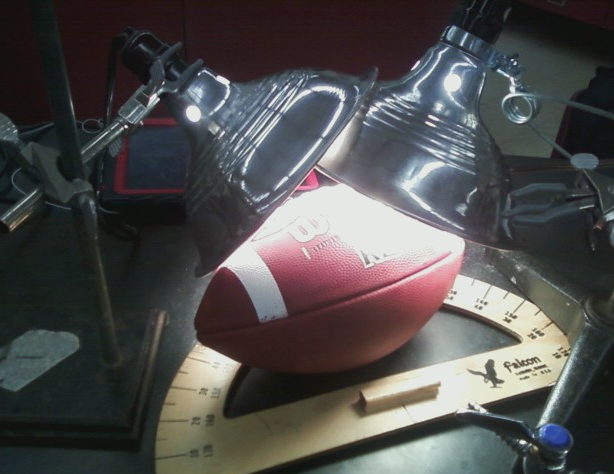
The key would be to get the ball hot before taking the initial pressure reading.  The easiest way to do this was with incandescent lamps.


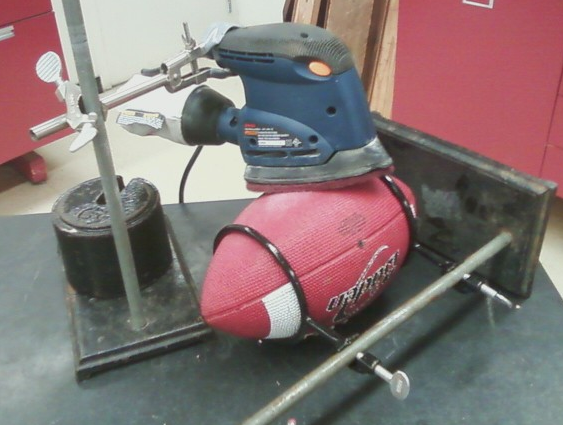
But Bill said that his team did not put the footballs in an oven.  Could the same increase in temperature be achieved by friction.  To find out, I had my students use electric sanders on the balls.  The sanders had scouring pads instead of sandpaper.  No damage was done to the leather.  


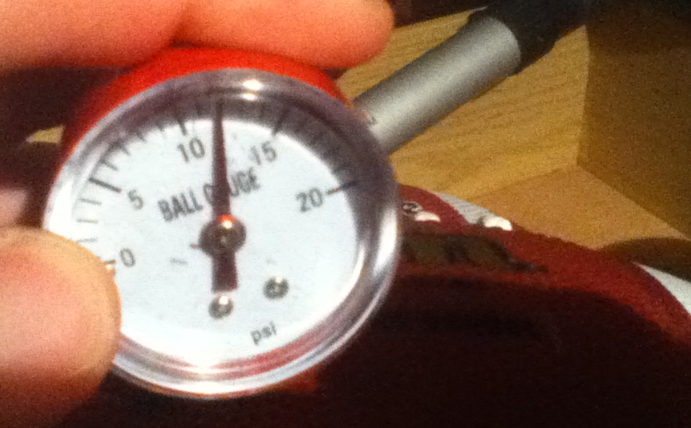
After working on the footballs for about 5 (noisy) minutes.  I took initial pressure readings.  Then I put the footballs outside (it was about 20F that day) for 15 minutes.  For the last step, I took the balls back inside and remeasured the pressure.  

Results:  After several trials (with different classes) the heated footballs dropped an average of 2.5 PSI between readings and the rubbed footballs dropped an average of 1.5 PSI.

Conclusion:  Bill Belichick may have been telling the truth.

Friday, November 14, 2014

Day 50 - BHS Wins The Molympics! - Mrs. Czerwinski - BHS Science Department


Molympics participants map pic.jpg


On October 23, 2014 chemistry students at high schools in Tucson AZ, Indianola IA, Highland IL, Burlington MA, Hudsonville MI, St. Louis MO, Las Cruces NM, Chesterland OH, Medina OH, Newberg OR, Exton PA, Harrison City PA, Montrose PA, and  the Beaconhouse Margalla Boys school in Islamabad Pakistan competed in the “Mole Olympics” (Molympics). Why? To learn about Avogadro’s number, 6.02 x 10²³ or one mole, and its importance in chemistry. The mole is a counting unit in chemistry, and represents the number of atoms in 12.0115 grams of carbon. Mole Day is celebrated from 6:02 am to 6:02 pm on 10/23 each year.  


trophy.jpg

Students honed their skills at estimation, measurement, dimensional analysis and problem solving by competing in the Tally Mark Challenge, the Sponge Squeeze, the Mole of Metals, the Stopper Tower and the Avogadro Fitness Challenge events. At stake were bragging rights and a trophy that will travel to the winning school each year.


This year’s top school is Burlington High School in Burlington, MA led by chemistry teacher Ms. Wendy Czerwinski. Two schools tied for second place. Highland High School in Medina, OH led by chemistry teacher Mr. Chris Luker and Tanque Verde High School in Tucson, AZ led by chemistry teacher Ms. Grazyna Zreda. In third place was Mayfield High School in Las Cruces, NM led by chemistry teacher Ms. Ann Gardner. Fourth place went to West Geauga High School in Chesterland, OH led by chemistry teacher Ms. Kristin Gregory. Hudsonville High School in Hudsonville, MI led by chemistry teacher Mr. Doug Ragan tied for fifth place with CS Lewis Academy of Newberg, OR led by chemistry teacher Ms. Pam Chambers.


The Molympics competition, now in its second year, is the result of a cross-country collaboration between five high school chemistry teachers who met and planned the event via Twitter. Teachers Wendy Czerwinski of Burlington MA, Ann Gardner of Las Cruces NM, Kristin Gregory of Chesterland OH, LuAnn Lee of Newberg OR, and Doug Ragan of Hudsonville MI also used Google apps for education to organize and run the event and to spread the word to participants worldwide. Based on the success of year two, next year’s Molympics should be bigger and better than ever.


molympicsbcce.jpg
Molympics Planning Team at the Biennial Conference on Chemical Education 2014
Kristin Gregory, Doug Ragan, Wendy Czerwinski Not pictured: Ann Gardner, LuAnn Lee


How many years would it take to make a mole of tally marks?


The Tower Event - How tall would a mole of stoppers be?
2014-10-23 10.35.01.jpg


Working in the Library
 IMG_5455.JPG
IMG_5452.JPG

IMG_5450.JPG

Avogadro’s Fitness Challenge- 6 Sit-Ups, 02 Side Steps, 10 Push-Ups, 23 Jumping Jacks


Now the Teams:

Period 1

IMG_5426.JPG

 Period 4
IMG_5427.JPG

Period 5
IMG_5430.JPG
     

 Period 6                      
IMG_5431.JPG

Period 7 
IMG_5424.JPG